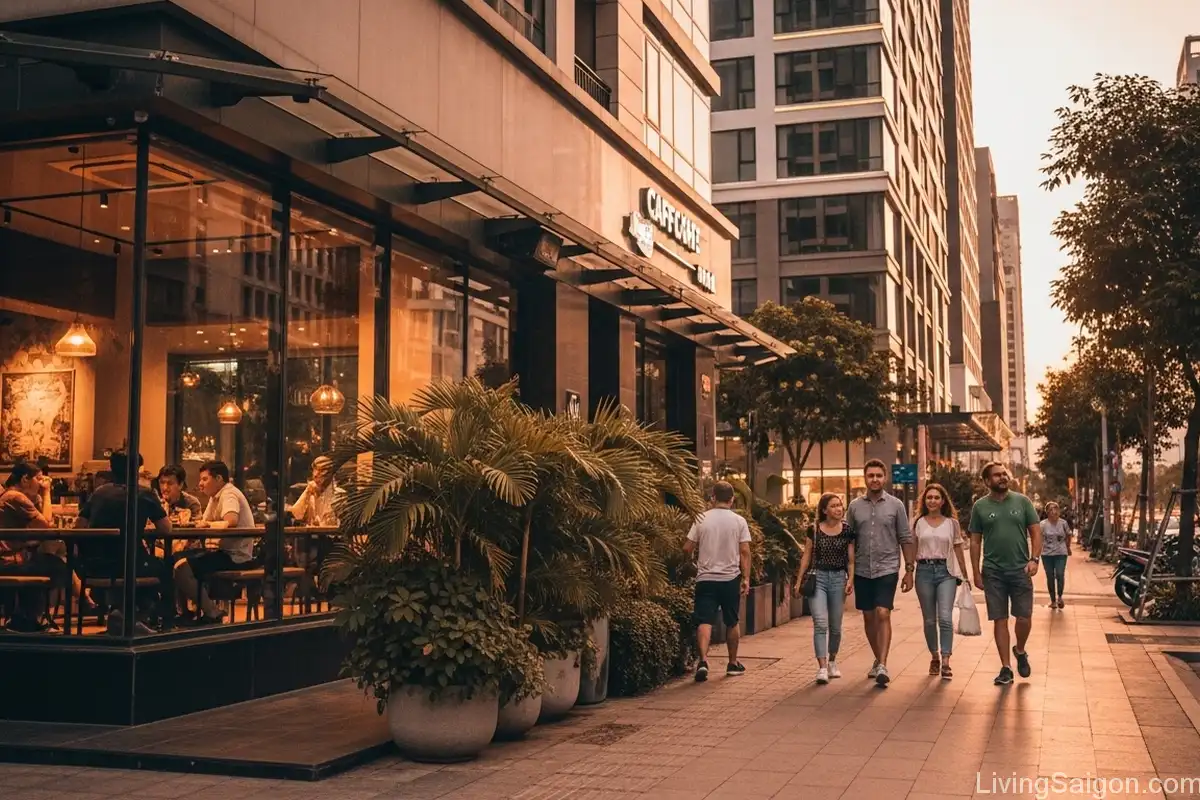
District 7 is Saigon’s planned district — the one that actually has footpaths wide enough to walk on, parks you can jog in without weaving through motorbikes, and residential developments where the roads were designed before the buildings went up rather than after. For expats who arrive from cities with functioning urban infrastructure and find Saigon’s organic, occasionally chaotic city center overwhelming, District 7 Saigon living offers something genuinely different: a quieter, more orderly residential environment that doesn’t require constant negotiation with your surroundings.
This guide covers the full picture of what living in District 7 Saigon actually involves — the sub-areas and what makes each one distinct, the rental market and current prices, the school options that make it a serious contender for families, the food and lifestyle scene, the commute reality, and an honest assessment of who District 7 is right for versus who might be better suited elsewhere. For the broader context of how District 7 fits within Saigon’s full neighborhood landscape, the expat areas in Saigon guide maps out all the options side by side.

Understanding District 7 Saigon Living: The Background
District 7 occupies the southern part of Ho Chi Minh City, separated from District 1 by the Kenh Te canal and connected to the city center primarily via the Nguyen Van Linh expressway and the Thu Thiem Tunnel. The district’s character was fundamentally shaped by the Phu My Hung development project — a joint venture between Taiwanese investors and the Vietnamese government that began transforming what was largely swampland into a master-planned urban zone in the mid-1990s.
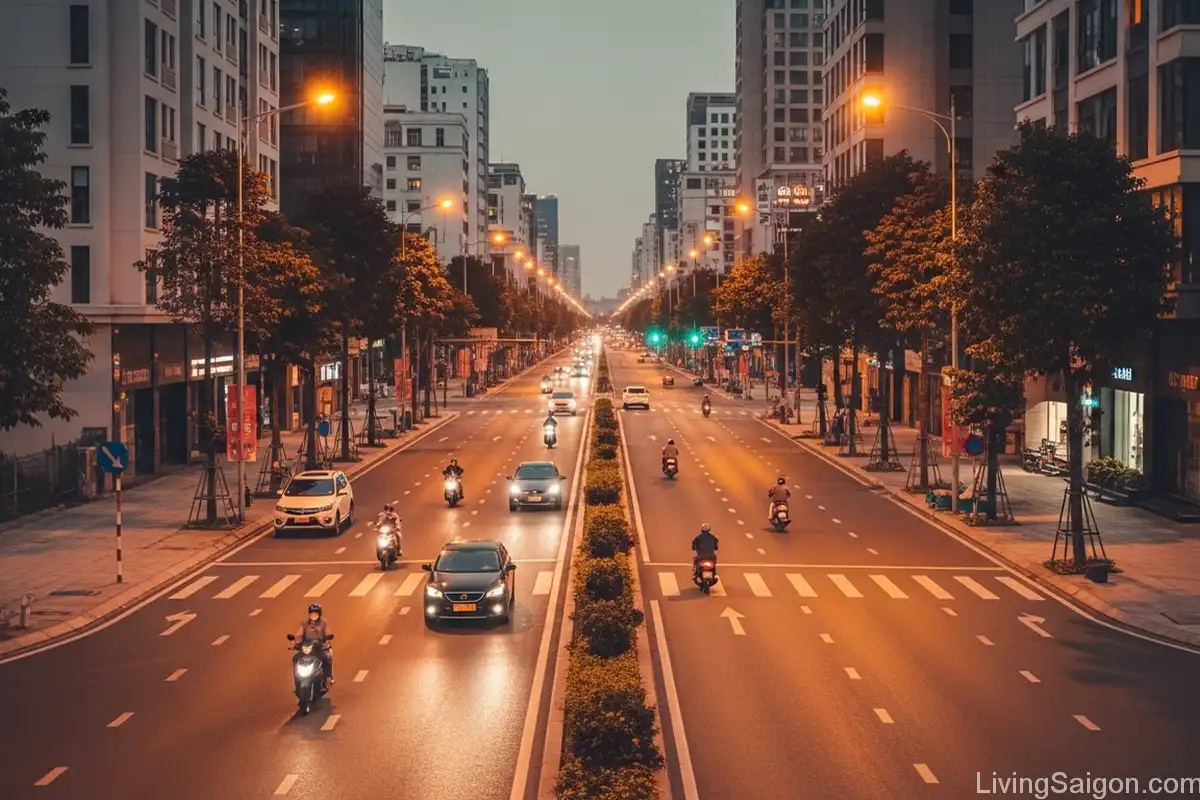
The Phu My Hung development is significant because it was designed with a genuine urban planning philosophy rather than allowed to develop organically. Wide boulevards with median strips and actual pavements. Dedicated green spaces and parks. Zoned areas for residential, commercial, and retail use. A drainage system that actually works. These are features that the historically organic parts of Saigon — districts that grew from fishing villages and colonial-era streets — don’t share, and they make District 7 feel fundamentally different from anywhere else in the city.
The first wave of residents was heavily international — Taiwanese and Korean expatriates in particular, drawn by the familiar urban planning aesthetics and by the fact that the Taiwanese developers actively marketed the area to overseas Asian communities. This demographic foundation is still visible in District 7 today: the Korean BBQ restaurants, Japanese grocery stores, Taiwanese bubble tea chains, and Korean-language signage that cluster in certain parts of the district reflect decades of community building by those expat groups. More recently, the expat population has diversified to include Western nationalities, Vietnamese professionals, and a growing contingent of remote workers who want space and quiet over urban density.
The Sub-Areas of District 7 Saigon Living
District 7 is large and internally varied. The experience of living in District 7 Saigon differs significantly depending on which part of the district you’re in — understanding the sub-areas before you start apartment hunting saves significant time and prevents you from committing to a location whose character doesn’t match your expectations.
Phu My Hung: The Planned Core
Phu My Hung is the original master-planned heart of District 7 and what most people mean when they refer to the district as a desirable residential area. The roads here are genuinely wide — four or six lanes with median planting that gives the area a subtropical boulevard character. The SC VivoCity mall anchors the commercial life of the zone, with a Lotte Mart hypermarket, a cinema, international restaurant chains, and the kind of retail infrastructure that reduces the number of trips you need to make across the city for everyday household needs.
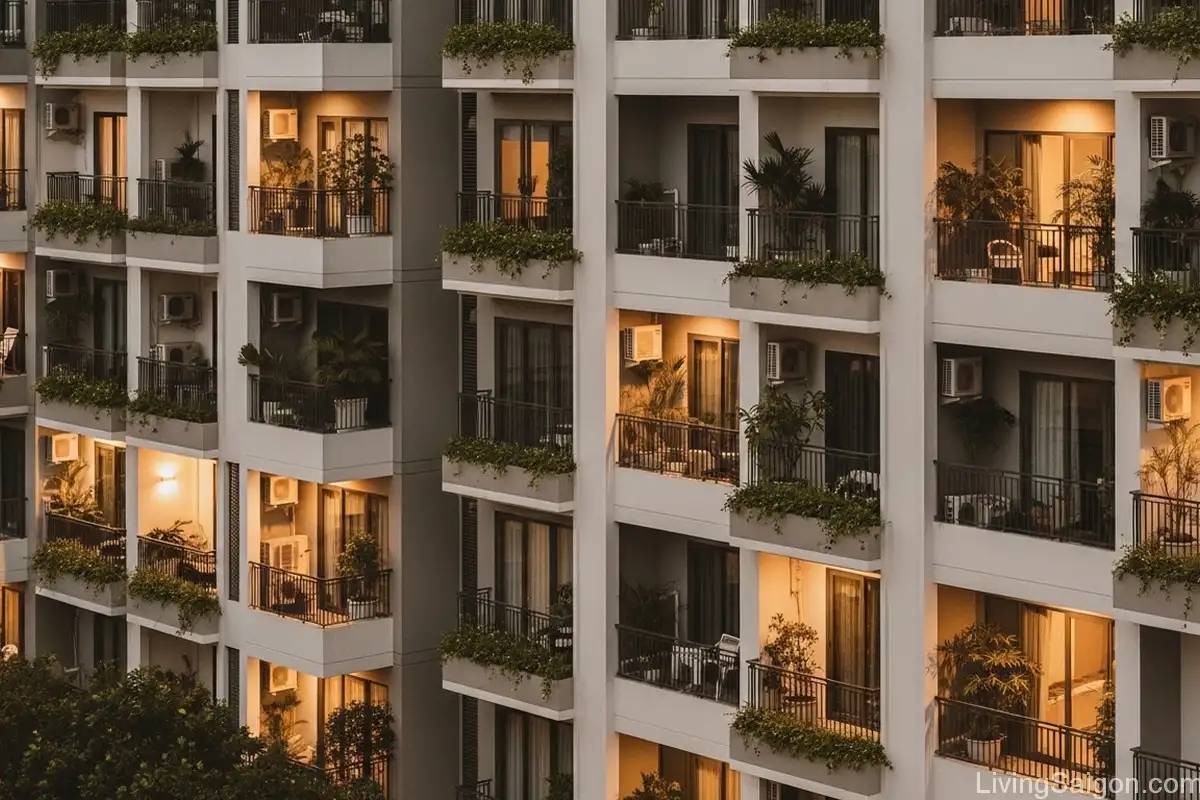
The residential development in Phu My Hung is primarily high-rise apartments — towers built by various developers over the past two decades with varying quality, age, and amenity packages. The better buildings have pools, gyms, landscaped podium areas, and twenty-four-hour security. Some of the older towers from the early 2000s show their age in common areas and lobby design, but often have excellent location and established green landscaping that newer buildings lack. The overall density in Phu My Hung is lower than in Districts 1 or 3, which gives the neighborhood its characteristic spacious feel.
Tan Phong and the Inner Streets
The Tan Phong ward and the streets directly north of the main Phu My Hung development zone offer a slightly different character — more local Vietnamese in feel, with a mix of older townhouses and villas alongside some newer apartment developments. Prices here are generally lower than in the heart of Phu My Hung, and the local food scene is better: the small restaurants and street stalls serving the Vietnamese residents who’ve lived in this part of the district for generations produce some genuinely excellent cooking at local prices.
For expats who want the District 7 address and the access to Phu My Hung’s amenities, but who are prepared to live a few minutes’ drive away from the main commercial core in exchange for lower rent and a more Vietnamese neighborhood character, this zone is worth exploring carefully.
The Riverside and Newer Developments
The southeastern edge of District 7, along the Saigon River and the canal system, has seen significant new development in recent years. Projects like Scenic Valley, Sunrise City, and several other large residential complexes have added substantial housing stock with river or canal views. These developments appeal to buyers and renters who want the District 7 lifestyle with the added dimension of water views — premium pricing applies, but the best units in the better-positioned buildings offer genuinely exceptional living environments.
District 7 Saigon Living: Rent and the Property Market
The rental market for District 7 Saigon living offers better value per square meter than Thao Dien or District 1 for comparable quality, while still providing a modern, well-amenitied apartment experience. The premium you pay for being in a nice area is real, but it’s lower here than in the city’s most expensive expat zones.
Current Rent Ranges by Property Type
Studio apartments in mid-range Phu My Hung buildings run $450–$650/month. One-bedroom apartments in well-maintained towers with pool and gym facilities sit at $550–$900/month — the wide range reflecting significant variation in building age, location within the district, and included amenities. Two-bedroom apartments, which are more abundant here relative to other districts because the larger buildings were designed with family living in mind, typically cost $800–$1,400/month for a good mid-range option. Premium two-bedrooms and three-bedrooms in the better buildings and riverside developments reach $1,500–$3,000/month.
Serviced apartments are less common in District 7 than in District 1, reflecting the market’s orientation toward longer-term family residents rather than short-stay business travelers. Most leases are signed for one year minimum, and landlords generally expect a two-month deposit. The market has enough international activity that English-speaking agents are accessible and most landlord communication can be handled in English with minimal friction.
What Your Money Gets You in District 7
The practical implication of District 7’s pricing is that families can get significantly more space here than in Thao Dien or District 1 at equivalent cost. A $1,200/month budget that buys a one-bedroom in Thao Dien typically buys a two-bedroom with pool and gym access in a decent District 7 building. For families with children who need bedrooms and living space, this space differential matters enormously to daily quality of life.
The trade-off is the commute. That additional room comes at the cost of greater distance from the city center and the somewhat longer trips required to access parts of the city that aren’t in the south. Whether that trade-off makes sense depends entirely on your specific situation — where you work, where your children’s school is, how often you need to cross the city, and how much you value having room to breathe at home. For the detailed cost comparison broken down by lifestyle and district, our article on the cost of living in District 7 gives the granular breakdown. Our apartment rental service in Saigon can also match you with current listings that fit your budget and requirements before you arrive.
International Schools in District 7
The international school landscape in and around District 7 is the second major driver of the district’s family expat population — alongside the physical spaciousness of Phu My Hung, the school infrastructure creates a self-reinforcing community of family expats that has defined District 7’s social character for decades.
The Major School Options
The International School Ho Chi Minh City (ISHCMC) has its main campus in District 7, following the International Baccalaureate curriculum and serving a diverse international student body from Early Years through the IB Diploma. It’s one of the most academically rigorous international schools in Saigon and draws families from across the city, though proximity to the campus is a significant factor in school bus logistics for younger children.
The Korean International School Ho Chi Minh City, Saigon South International School, and several other institutions operating in the District 7 and surrounding area serve specific national communities and curriculum preferences. The Korean and Japanese international schools in particular reflect the historic demographic concentration of those nationalities in District 7 and offer genuine community continuity for families who want their children educated in their home country’s system while living abroad.
For families considering District 7 primarily because of a specific school, visiting the campus and understanding the bus route coverage before committing to an apartment location is essential — the district is large enough that being in the wrong part of it can make the school run significantly more complicated than being in the right part. Our guide to living in District 7 includes a section on which apartment zones work best for each major school’s bus network.
Food and Lifestyle in District 7 Saigon
The food and lifestyle scene in District 7 Saigon living is genuinely good, though different in character from what you find in the more organically developed parts of the city. The district has developed its own food identity over the years, shaped significantly by its Korean and Japanese expat communities and by the higher average spending power of its resident population.
Korean and Japanese Dining
District 7 has the strongest concentration of Korean and Japanese restaurants in Saigon, and they’re genuinely excellent — not tourist-facing versions of Korean BBQ or Japanese ramen, but restaurants that serve the local Korean and Japanese expat communities and have been refined over years of catering to customers who know exactly what authentic should taste like. Walking the streets of Phu My Hung in the evenings, the smell of Korean barbecue charcoal and the sound of Japanese pop music from various restaurant sound systems create an atmosphere unlike anything in the rest of the city.
Beyond the Korean and Japanese core, the district has a growing range of international options — Western cafes and brunch spots, Vietnamese fine dining restaurants that have opened to serve the higher-income resident base, craft beer bars, and the multinational food court options that the SC VivoCity mall concentrates under one roof. The overall food quality in District 7 is high relative to price, and the absence of the inflated tourist-facing pricing that affects District 1 restaurants means you get better value at similar quality levels.

Parks, Gyms, and Outdoor Life
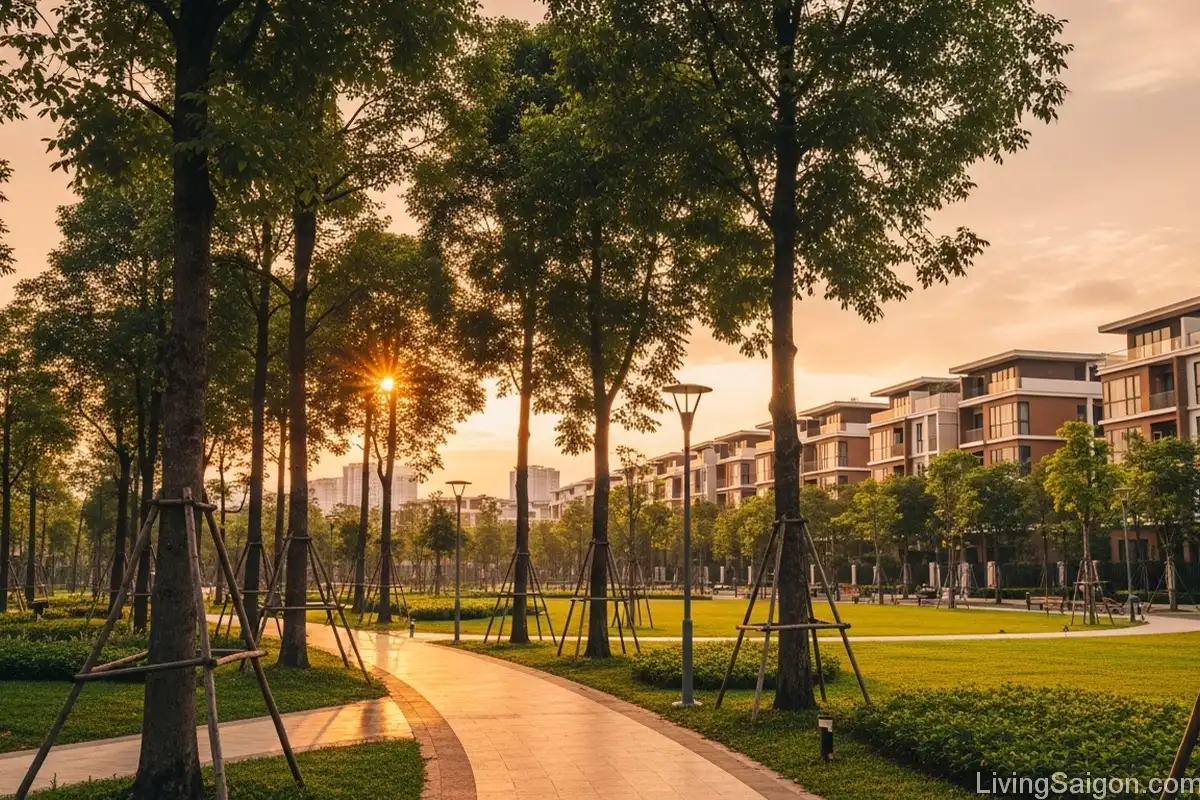
One of the genuine advantages of District 7 Saigon living over more central neighborhoods is the access to outdoor space. The parks in Phu My Hung — Crescent Lake park, the various pocket parks within the residential developments, the jogging paths along the canal — provide outdoor recreation options that simply don’t exist at comparable scale anywhere in District 1 or most of Binh Thanh.
Early morning in Crescent Lake park is one of the more pleasant social experiences in Saigon — Vietnamese families doing tai chi, Korean joggers, expat dog walkers, children on bicycles, and the entire range of the district’s diverse population sharing the same outdoor space in the cool morning hours before the heat of the day makes outdoor activity uncomfortable. This kind of accessible public outdoor space is a significant quality-of-life factor for families and for anyone who values the ability to exercise outdoors without it being a special expedition.
Gym and fitness options are well-developed in District 7, reflecting both the spending power of the resident base and the space availability that allows for larger fitness facilities than the central districts can accommodate. California Fitness operates a large branch in the district; several boutique gyms, CrossFit boxes, and yoga studios serve the expat and wealthy Vietnamese communities within the Phu My Hung zone.
The Commute: Honest Numbers
The commute question is the most important practical consideration for anyone seriously evaluating District 7 Saigon living, and it deserves an honest answer rather than the optimistic framing that many area guides provide.
From the heart of Phu My Hung to District 1 via the Thu Thiem Tunnel during off-peak hours (10am–3pm on a weekday), the journey takes approximately twenty to thirty minutes by Grab car. During the morning rush (7:30–9am) or the evening rush (5–7pm), the same trip regularly takes forty-five to sixty minutes or longer, as the tunnel approach roads and the roads feeding into and out of the southern part of the district back up significantly. This is a real cost — three to five hours of weekly commuting time for someone making daily trips to District 1 — that doesn’t appear in any apartment listing but shapes the daily experience of life in the district profoundly.
The practical implication for your decision is clear: if your daily routine requires regular presence in District 1 or the city’s northern districts, District 7 is a significant commuting proposition. If you work from home most days, work in the south of the city, or have a school-centered daily routine that keeps you within the district most of the time, the commute cost is largely irrelevant. Be precise about your actual weekly travel requirements before treating the commute question as settled. Our broader guide to where to live in Saigon covers the commute calculus for each major expat neighborhood.
The Expat Community in District 7
The community life of District 7 Saigon living is built primarily around families and the school network that connects them. The weekly rhythms of school pickup and drop-off, the sports clubs and cultural events organized through the international schools, and the social infrastructure that develops when you have a stable population of family expats living in relative proximity — these elements create a community character that’s markedly different from the more transient, nightlife-oriented social scene of Districts 1 and 3.
The Korean expat community in particular has built a remarkably self-contained social infrastructure in District 7 — Korean-language Facebook groups, Korean-run community organizations, Korean church communities, and the range of Korean-specific businesses that have made the district a genuinely liveable home for thousands of Korean families who might otherwise find Saigon difficult to navigate. Expats from other nationalities who choose District 7 plug into this existing social infrastructure to varying degrees, but the district’s social character is inevitably shaped by the Korean community’s scale and cohesion.
Western expats in District 7 have their own networks — primarily organized through the international schools — and the district’s Facebook expat groups are active and useful for practical information. The pace of social life is calmer and more family-oriented than in Thao Dien; weekend activities center on parks, brunch spots, and family-friendly events rather than the bar and cafe circuit that anchors social life in the city’s more singles-oriented neighborhoods. For a deeper look at what daily life actually looks like for expats who’ve chosen District 7, our article on things to do in District 7 covers activities, events, and social options across the district.
District 7 Saigon Living vs Thao Dien: Making the Choice
The comparison between District 7 and Thao Dien comes up so frequently in expat circles — and the two neighborhoods are so often presented as the primary alternatives for family expats — that a direct comparison is worth making explicitly.
Choose District 7 If:
Your children’s school is in District 7 or the southern part of the city, and the commute to school matters more than the commute to the center. You work from home or your office is south of the river. You want significantly more living space per dollar than Thao Dien provides. You prefer a quieter, more ordered urban environment over the organic energy of an older expat enclave. You’re part of, or want to be close to, the Korean or Japanese expat community. You have a car and the space to park it without urban density making it impractical.
Choose Thao Dien If:
Your children’s school is in or near Thao Dien, specifically BIS or AIS. You commute regularly to District 1 or the central business district. You prioritize the expat social infrastructure and the ability to build friendships quickly through an established community network. You want the densest cafe and restaurant scene of any expat area in the city. The school-centered community of District 7 is less important to your lifestyle than the broader expat social scene of the east bank.
For many families, the decision ultimately comes down to the school — and once the school is chosen, the neighborhood choice follows naturally. For those genuinely undecided between the two, our detailed apartments in District 7 guide and the parallel Thao Dien resources give you the ground-level detail you need to make the comparison on practical rather than abstract grounds. The expat life in Saigon guide provides context on what the social landscape looks like across the city’s different neighborhoods, which is useful reading before committing to either option.
Practical Notes for Arriving in District 7
A few things worth knowing before you arrive that most guides leave out.
The SC VivoCity mall solves most practical household setup needs — it has a Lotte Mart with imported food, a pharmacy, mobile phone shops, electronic goods, household goods, and the range of international food outlets and cafes that make the first week in a new city less logistically stressful. Plan your first few days assuming VivoCity solves most things.
The district has the city’s best parking infrastructure, reflecting its car-oriented planning heritage. If you own or plan to own a car in Saigon — something that’s genuinely more practical in District 7 than in most other parts of the city — the parking situation here is dramatically easier than in the center. Most apartment buildings have dedicated parking; most commercial venues have dedicated lots; the roads are wide enough to allow this to function without the constant friction that car ownership creates in Districts 1 and 3.
Grab availability in District 7 is generally good within the district and for trips to the center, but can be slower to respond than in more central areas late at night or very early in the morning. Owning a motorbike is useful for flexibility, particularly for school runs and quick local trips within the district. The district’s road layout also makes cycling genuinely feasible for shorter trips — something that’s largely impractical in the chaotic inner-city streets.
The cost of living in Saigon guide gives the full budget picture that helps contextualize what District 7 costs relative to the city’s other neighborhoods — essential reading if you’re still working out whether the district fits your financial planning. For the apartment search itself, reaching out to our apartment rental service in Saigon gives you access to agents who work specifically in District 7 and can shortlist properties based on your school, budget, and lifestyle requirements before you arrive.