

Saigon does coffee differently from anywhere else in the world. The city that gave the world cà phê sữa đá — strong, dark Vietnamese drip coffee poured over a glass packed with ice and sweetened with condensed milk — has built on that foundation over the past decade into one of Asia’s most dynamic and genuinely interesting cafe cultures. The best cafes in Saigon span an extraordinary range: tiny street-level stalls where a plastic cup of ca phe da costs 15,000 VND and tastes like the distilled essence of the city, to multi-story specialty venues with hand-selected single-origin beans, precise pour-over methodology, and the kind of obsessive quality that would satisfy a barista in Tokyo or Melbourne.
What makes Saigon’s cafe scene particularly compelling is that both ends of this spectrum — and everything in between — are excellent in their own way, and all of them coexist in the same city, sometimes on the same street. This guide covers the full range: what the different cafe types in Saigon are, where to find them, what to expect from each, and how to orient your cafe life in the city whether you’re visiting for a week, working remotely for three months, or building a daily routine as a long-term resident. For the broader food and drink landscape that cafes inhabit, the food in Saigon guide provides context.
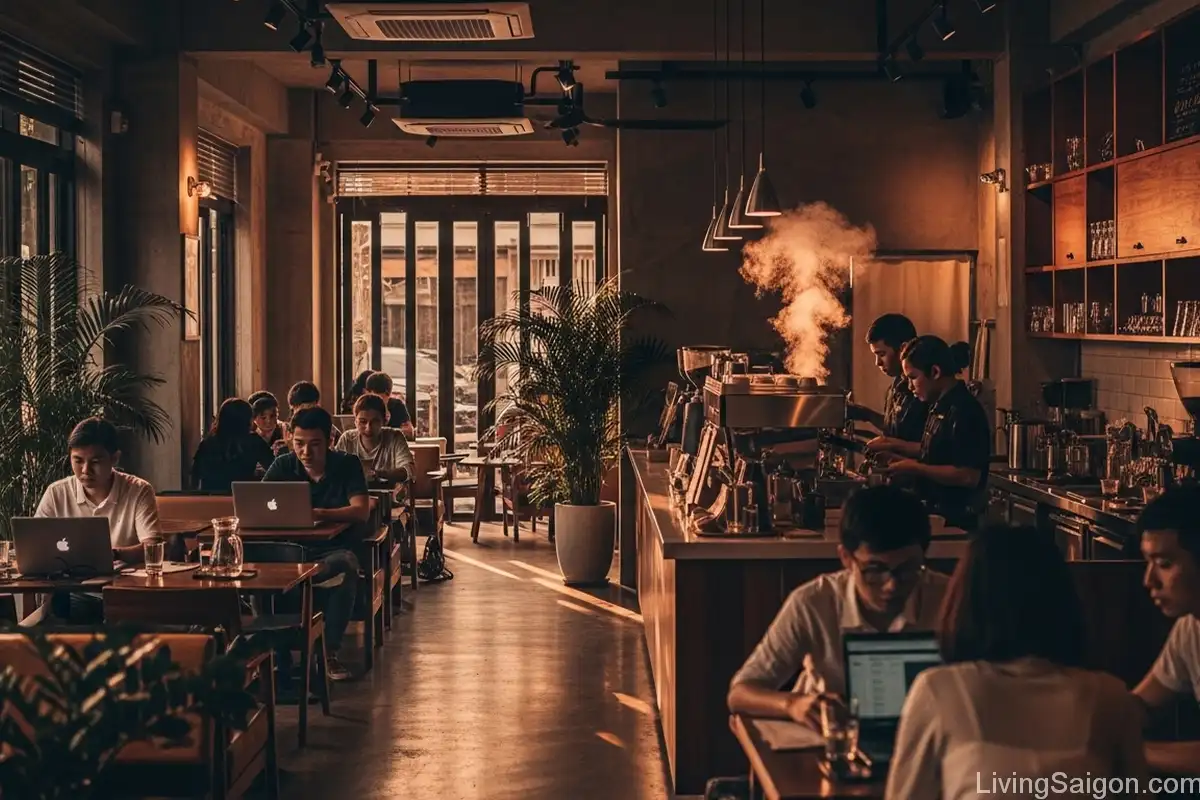
Why Saigon Has Some of the Best Cafes in Southeast Asia
The coffee culture of Ho Chi Minh City has deep roots. Vietnam is the world’s second-largest coffee producer — a position it achieved through the cultivation of robusta coffee in the Central Highlands, a bean variety that produces stronger, more bitter, higher-caffeine coffee than the arabica that dominates most of the world’s specialty coffee market. Vietnamese coffee culture developed around robusta: the traditional phin filter, the slow drip, the condensed milk that balances the bitterness, and the social ritual of sitting and waiting for the coffee to drip that gives Vietnamese cafe culture its distinctive unhurried quality.
Over the past decade, a new wave of Vietnamese coffee professionals — many trained abroad or exposed to the global specialty coffee movement — has brought arabica, precise roasting, and international cafe standards into conversation with this tradition. The result is a cafe scene that is uniquely Vietnamese: not an imitation of third-wave coffee culture imported from Portland or Melbourne, but a synthesis that takes the best of both traditions and produces something genuinely its own.
The economics also help. Good commercial real estate in Saigon, while increasingly expensive, remains significantly cheaper than in comparable Asian cities. This means cafe owners can invest in quality — in beans, in equipment, in interior design, in trained staff — at cost structures that allow them to price their product accessibly. A genuinely excellent specialty pour-over in Saigon typically costs $3–5 USD. The same quality in Singapore or Hong Kong would cost two to three times as much. This economic reality has enabled an unusual density of high-quality cafes across the city, which in turn drives competition and continuously raises the overall standard.
The Different Types of Best Cafes in Saigon
Understanding the different categories of cafe in Saigon helps enormously when choosing where to go for different purposes. The city’s cafe scene is internally diverse, and the right choice depends entirely on what you’re looking for.
Traditional Vietnamese Cafes and Street Stalls
The oldest and most accessible form of Saigon’s cafe culture requires nothing more than walking down a residential street and looking for a low plastic stool arrangement with a woman or man behind a small cart or narrow counter. The coffee at these spots is made in the traditional phin filter — a small stainless steel filter that sits on top of a glass and drips Vietnamese robusta coffee slowly through compressed grounds — and served with condensed milk (or black, or with fresh milk at some spots), either hot or over ice.
The quality varies, but the best neighborhood coffee stalls in Saigon produce something genuinely exceptional: strong, complex, slightly bitter, with an almost syrupy body and the deep caramelized sweetness of condensed milk as counterpoint. The price is 15,000–25,000 VND (about $0.60–$1) for a glass. The social experience — sitting on a small stool at pavement level, watching the street activity, possibly exchanging a few words with the stall holder or nearby regulars — is one of the most distinctly Saigon experiences available to anyone living in or visiting the city.
These stalls don’t appear on Google Maps. They’re found by walking, by following the smell of coffee and charcoal, and by the simple heuristic that any street in a Vietnamese residential neighborhood will have at least one within a five-minute walk.
Minimalist Specialty Cafes
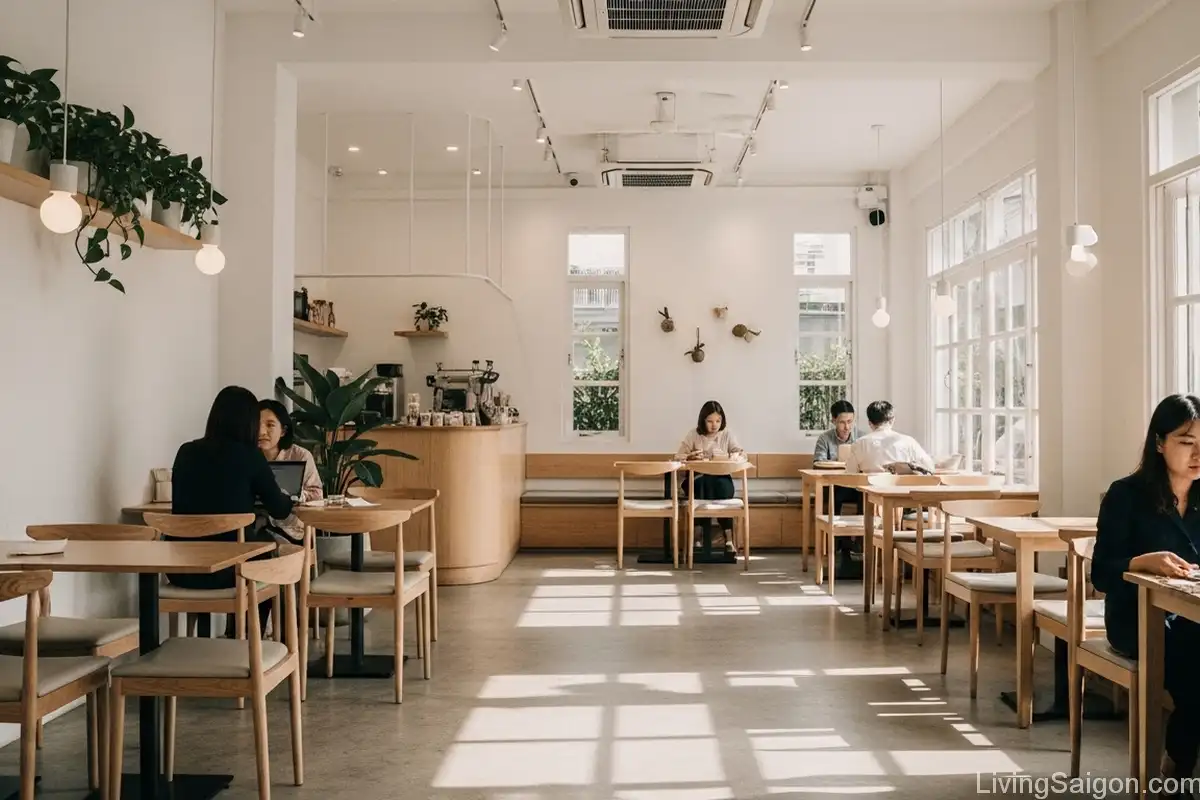
The specialty cafe movement in Saigon has produced a remarkable range of venues dedicated to serious coffee — precise sourcing, skilled roasting, and careful preparation. These places have the physical characteristics you’d recognize from any global specialty cafe context: pour-over equipment, espresso machines with visible quality, manual grinders, small menus focused on the coffee itself, and interiors that prioritize clean lines and natural materials over decorative complexity.
The Vietnamese specialty cafe scene has its own distinct aesthetic that separates it from Western equivalents: a preference for exposed concrete and aged wood, smaller spaces that feel intimate rather than cavernous, natural light through large windows or open facades, and a consistent use of plants — tropical vegetation, hanging greenery, potted trees — that give even a primarily industrial space a warm, organic quality. The best cafes in Saigon in this category include venues that have developed genuine regional and international reputations for their sourcing and preparation, and that attract a serious coffee-focused clientele of Vietnamese and international customers.
Coworking-Friendly Cafes
The explosion of remote work has made Saigon — already an attractive destination for digital nomads — into one of the world’s great cities for laptop-based cafe working. A significant number of the city’s cafes have adapted explicitly to this reality: stable high-speed wifi, power outlets at or near most seats, comfortable seating with table surfaces at working height, enough ambient noise to feel productive without being distracting, and a general policy that accepts customers who nurse a single coffee for three or four hours.
The best cafes in Saigon for working have figured out a model that works for both the business and the customer: morning periods are more focused and quieter, afternoon periods more social, and the pricing is typically structured so that a coffee plus one food item represents a fair exchange for several hours of seating. The areas around Thao Dien, parts of District 3, and the creative strip in Binh Thanh have the highest density of genuinely good coworking cafes. Specific recommendations for the best work-from-cafe spots by neighborhood are covered in our dedicated guide to work-friendly cafes in Saigon.

Hidden Cafes and Garden Retreats
One of the most distinctive features of Saigon’s cafe culture is the persistence of hidden venues — places you find through a narrow doorway, up an unmarked staircase, or through a ground-floor shop that conceals a garden courtyard behind it. Saigon’s dense urban fabric, with its narrow shophouses and deep plots, has enabled an architecture of concealment that cafe culture has exploited brilliantly: the nondescript street frontage that opens into a beautifully planted garden, the apartment building lobby that connects to a rooftop terrace, the lane entrance that leads to a compound of converted colonial-era structures.
These hidden cafes are the ones that circulate on Instagram and Pinterest and draw visitors who’ve done their research. They’re genuinely worth finding, but finding them is part of the experience — they don’t announce themselves, and arriving at one for the first time, after following vague directions and ducking through an unexpected entrance, produces a satisfaction that is itself part of what makes Saigon’s cafe culture distinctive. Our guide to hidden cafes in Saigon covers the most interesting and currently active secret-garden venues across the city’s different districts.

Rooftop Cafes and View Venues
Saigon’s vertical development has created a city with extraordinary views, and the cafe scene has responded by claiming the high ground. Rooftop cafes — distinct from the rooftop bars that serve primarily alcohol — offer coffee and cafe-style food alongside the city’s most dramatic visual perspectives. The best rooftop cafes in Saigon operate in the daytime and early evening, when the light is interesting and the heat is manageable, and they create an experience that’s genuinely different from anything a ground-level cafe can offer.
The view from a good Saigon rooftop cafe encompasses the river, the cluster of skyscrapers in District 1, the complex tiled roofscape of the older residential districts, and the visual energy of a city that is simultaneously ancient and in rapid transformation. The coffee at rooftop venues is typically less focused than at dedicated specialty cafes — the experience is primarily about the setting — but the best of them have invested enough in their beverage program to make the coffee itself worth ordering on its own merits.

Best Cafes in Saigon by Neighborhood
Saigon’s cafe culture is distributed across the city in patterns that reflect the different neighborhoods’ characters. Knowing which areas have the best cafe infrastructure helps enormously when you’re choosing where to spend an afternoon or planning your work-from-cafe week.
Thao Dien: The Expat Cafe Hub
Thao Dien has the highest density of internationally oriented cafes in Saigon — places that understand the requirements of remote workers, that offer English-language menus as standard, and that have developed the kind of ambiance that appeals to the neighborhood’s diverse expat community. The area around Nguyen Van Huong and the connecting streets has a concentration of specialty roasters, coworking cafes, and brunch-oriented venues that is unmatched anywhere else in the city.
Thao Dien cafes tend toward the polished and comfortable end of the spectrum — well-designed spaces with reliable wifi and consistent quality. They’re excellent places to work or spend a long morning. They’re slightly less surprising than the hidden cafes and local neighborhood spots of other districts, which is the natural consequence of serving a community that has developed specific expectations. Our complete guide to cafes in Thao Dien covers the current scene with specific venue recommendations by purpose — working, socializing, Instagram photography, and serious coffee.
District 3: The Cafe Culture Heartland
District 3, immediately north of the District 1 city center, is where much of Saigon’s specialty cafe scene has its deepest roots. The streets around Vo Van Tan, Tran Quy Cap, and the French Quarter-adjacent blocks have been home to some of the city’s most influential cafe openings over the past decade. The mix here is excellent: genuine specialty roasters with serious coffee programs, beautiful old buildings repurposed into cafe spaces with genuine architectural character, and a clientele of Vietnamese coffee enthusiasts and expats who know exactly what good coffee tastes like.
District 3 cafes are typically less tourist-facing than District 1 venues and less aggressively expat-focused than Thao Dien. The result is a more Vietnamese feel with higher average quality — the places that the city’s coffee community recommends to each other rather than to visitors. For expats living in Districts 1, 3, or Binh Thanh, District 3 is the natural cafe hunting ground for the best of what the city has to offer in a serious specialty context.
District 1: Convenience and Variety
District 1’s cafe scene is vast and varied — everything from tourist-facing chain cafes on the main streets to excellent hidden specialty venues in the side streets and alleys off Dong Khoi and Ly Tu Trong. The density of foot traffic means that District 1 can sustain a wider range of cafe types than any other single area, including some genuinely excellent options for visitors who want quality without the effort of exploring further afield.
The challenge in District 1 is filtering the genuinely good from the mediocre-but-visible. The cafes on the main tourist strips charge premium prices for average coffee in photogenic settings. The genuinely good cafes are in the secondary streets and converted shophouses that require five minutes of walking off the main drag. Instagram spots and dedicated coffee venues occupy different physical geographies even when they’re just around the corner from each other. Our guide to Instagram cafes in Saigon covers the most photogenic venues with the additional filter of which ones are also genuinely worth sitting in for the coffee and experience rather than just the photograph.
Binh Thanh and Beyond: The Emerging Scene
The Pham Viet Chanh strip in Binh Thanh has developed a cafe scene over the past few years that feels more independent and less commercial than the Thao Dien or District 3 equivalents. The cafes here cater primarily to Vietnamese customers and the small but growing expat community of the area, which means the pricing is more local, the atmosphere is less curated, and the quality — at the best places — is genuinely excellent without the premium that comes with being in a more established cafe destination.
Parts of District 10, Tan Binh, and even the outer reaches of the inner districts have developed their own neighborhood cafe scenes that reward exploration for anyone who’s been in the city long enough to be curious about what’s happening beyond the main expat zones. The cafe culture of these areas is primarily Vietnamese in orientation but occasionally produces genuinely extraordinary venues — the hidden garden cafe in a converted house that has no social media presence but has been serving the neighborhood for fifteen years, the specialty roaster that opened without fanfare in a non-obvious location and builds its customer base entirely through word of mouth.
The Vietnamese Coffee Experience: What to Order
Navigating a Vietnamese cafe menu confidently requires knowing a handful of terms and what they mean. The ordering vocabulary of the best cafes in Saigon covers both the traditional Vietnamese formats and the international specialty coffee preparations that the modern cafe scene has added to the repertoire.
The Vietnamese Classics
Cà phê sữa đá (iced coffee with condensed milk) is the entry point — the drink that defines Vietnamese coffee culture and that almost every cafe in the city does well. The hot version (cà phê sữa nóng) is less common but available and excellent in cooler conditions. Cà phê đen (black coffee, no milk) is for those who want to taste the coffee itself without modification. Cà phê trứng (egg coffee) is a Hanoi specialty that has made its way into the Saigon scene at various cafes — a rich, creamy mixture of egg yolk beaten with condensed milk and sugar, served over coffee, with a texture somewhere between a tiramisu and a sabayon.
Bạc xỉu is the sweeter, milkier version of Vietnamese iced coffee — more milk than coffee, very sweet — that appeals to those who want the cafe experience without the intensity of full-strength Vietnamese robusta. Sinh tố (Vietnamese smoothies) and nước ép (fresh-pressed juices) are standard offerings at most cafes alongside the coffee itself, and at the best places they’re made with genuinely fresh local tropical fruit.
Specialty Coffee in Saigon
At the city’s specialty cafes, the international vocabulary of third-wave coffee applies: single-origin pour-overs, AeroPress preparations, cold brew, and the full espresso-based menu of flat whites, cortados, lattes, and cappuccinos. The quality of specialty coffee in Saigon’s best venues is genuinely impressive — the sourcing often includes Vietnamese arabica from the Central Highlands alongside imported Ethiopian, Guatemalan, and Kenyan beans, and the preparation is executed with the kind of precision that reflects serious training and investment.
One of the pleasures of Saigon’s specialty cafe scene is that the best cafes have thought carefully about how Vietnamese coffee tradition intersects with international specialty practice — some offer Vietnamese-style preparations made with high-quality arabica beans rather than robusta, which produces a flavor profile quite different from both the traditional Vietnamese cafe and the typical international specialty cafe. These hybrid preparations are worth seeking out specifically because they don’t exist anywhere else.
Cafe Culture as Daily Life in Saigon
For expats living in Saigon, the cafe is not merely a place to get coffee — it’s an infrastructure of daily life. The city’s culture of extended cafe sitting, the affordability of spending several hours at a table with a single drink, and the sheer density and variety of options mean that cafes function as offices, meeting rooms, social venues, and quiet retreats in ways that are rare even in other cafe-forward cities.
The working-from-cafe culture in Saigon is particularly well-developed. A significant portion of the city’s digital nomad and remote worker population uses cafes as their primary work environment, either by choice or because their apartment lacks a suitable workspace. The best cafes in Saigon for remote workers understand this and have configured their spaces and policies accordingly. The expat cafe community has its own social ecosystem — the people you see at the same cafes consistently become faces you recognize and eventually people you know — that contributes meaningfully to building a social life in a city where you might not have pre-existing connections.
For the broader lifestyle context of how cafes fit into Saigon’s expat social scene, the expat life in Saigon guide covers the full social landscape. And for those who want to connect the cafe experience with the city’s brunch culture — the late-morning food-and-coffee ritual that has become one of the defining social events of Saigon’s expat weekend — the brunch in Saigon guide covers the best spots where good coffee and serious weekend food share the same table.

What Makes the Best Cafes in Saigon Stand Out
After spending time across the full range of Saigon’s cafe scene, the qualities that consistently distinguish the genuinely great venues from the merely good ones come down to a small number of factors that aren’t always immediately visible.
The Coffee Comes First
The cafes that matter in Saigon’s scene — the ones that the city’s coffee community respects and returns to — are places where the coffee itself is the product, not the backdrop to a photo opportunity or a lifestyle aesthetic. The interior design at the best venues is excellent, but it’s in service of the coffee experience rather than a substitute for it. You can feel the difference in the first sip.
Attention to the Vietnamese Coffee Tradition
The cafes that understand Saigon’s coffee culture at its deepest level are those that have thought carefully about what traditional Vietnamese coffee actually is and what it offers, rather than simply importing an international specialty coffee framework and overlaying it on the local context. The best of them serve excellent cà phê sữa đá alongside excellent pour-overs, understanding that these aren’t competing offerings but complementary expressions of a city with a genuinely complex coffee identity. For the food and drink experience that surrounds and supports the cafe scene, the local food in Saigon guide covers the eating context that makes Saigon’s cafe culture so embedded in daily life.
Getting Into the Rhythm
The final thing worth knowing about the best cafes in Saigon: they reward regularity more than discovery. The cafe you visit once for Instagram is a different experience from the cafe you visit three times a week until the barista knows your order, until you have a preferred table, until the place becomes part of the texture of your life in the city. Saigon’s cafe culture at its deepest is not a list of highlights to visit — it’s a practice, a daily ritual, a way of being in the city that accumulates over weeks and months into something genuinely meaningful. Finding your cafes — the two or three places that become yours — is one of the quiet pleasures of building a life in Saigon, and it’s available to anyone who approaches the city with the time and curiosity to let it happen.