

There are two ways to eat in Saigon. The first is familiar: restaurants with English menus, delivery apps, international cuisine that travels well and surprises no one. The second is what this guide is about. Local food Saigon means pulling up a plastic stool at a corner stall before 8am, pointing at what the table next to you is eating, and paying less than two dollars for a bowl that you’ll still be thinking about three years later. It means following the sound of a wok and the smell of charcoal into an alley you would never have noticed from the main road. It means learning, gradually, that the best meals in this city almost never happen in places that are easy to find.
This guide is written for people who want to eat the real Saigon — expats building a life here, visitors who want to go beyond the tourist trail, food-curious travelers who know that cuisine is one of the fastest ways into a culture. For the broader picture of the city’s dining scene from street stalls to rooftop restaurants, start with the food in Saigon overview. This guide goes deeper into the local side specifically.

What Makes Local Food in Saigon Different
Southern Vietnamese cuisine — the cooking tradition that shapes local food in Saigon — is distinct from what you find in Hanoi and distinct again from what gets served in Vietnamese restaurants abroad. It’s sweeter, more generous with fresh herbs, and more open to influence than the more austere cooking of the north. The region absorbed flavors from Chinese immigrant communities (particularly Cantonese and Teochew), from the Khmer culinary traditions of the south, and from the French colonial period — and the result is a kitchen that is confidently, specifically its own.
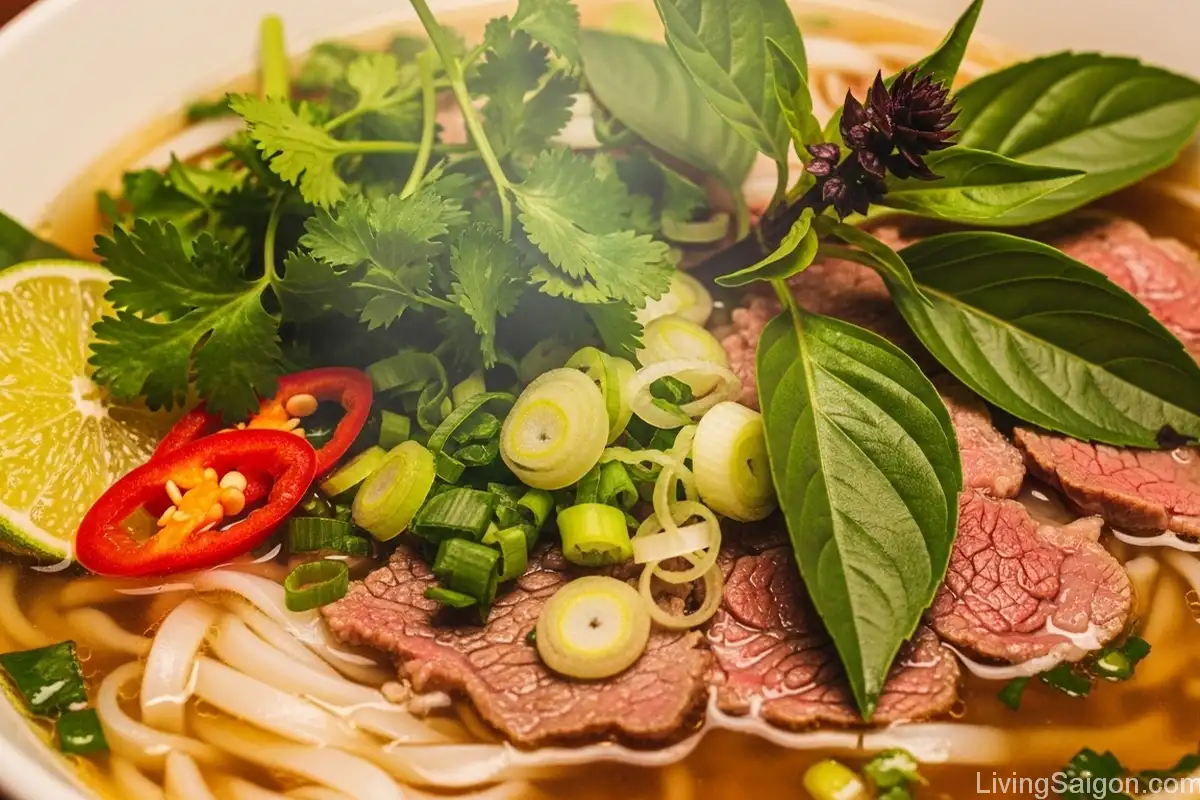
The flavors are built on balance. A good bowl of phở in Saigon is not just broth and noodles — it’s a system of contrasting elements: the rich, slow-cooked stock; the cool crunch of bean sprouts added at the table; the bite of fresh chili; the aniseed note of Thai basil; the bright acidity of a squeeze of lime. This interplay of hot and cool, rich and fresh, soft and crunchy runs through almost every dish in the southern Vietnamese kitchen.
The other thing that defines local food here is the culture of specialization. Many of the city’s best eating spots do one thing — or a very small number of things — and have been doing that same thing for decades. The pho shop that opens at 5am and closes when it sells out. The banh mi cart that has occupied the same corner for thirty years. The com tam stall where the charcoal grill is lit before 6am and the lunch rush clears by 1pm. This concentration produces food that no generalist restaurant can match.
The Essential Local Food of Saigon
Pho — The Bowl That Defines the Morning
In Saigon, pho is a morning ritual. The best pho shops open before dawn, build their broth through the night, and sell out by mid-morning. The southern version is richer and slightly sweeter than Hanoi pho, served with a plate of fresh accompaniments — bean sprouts, Thai basil, sawtooth herb, lime wedges, fresh chili, hoisin sauce — that you add yourself at the table.
Finding good pho is not difficult in Saigon; finding great pho requires knowing what to look for. The broth should be clear, not cloudy, with a deep fragrance that comes from properly charred ginger and onion and a balanced blend of spices. The noodles should be fresh, not the dried variety. The meat — typically phở bò (beef, in various cuts) or phở gà (chicken) — should be cooked precisely, not overcooked into grey uniformity. A line out the door before 8am is always a good sign.
Bún Bò Huế — The Spicy Bowl That Rivals Pho
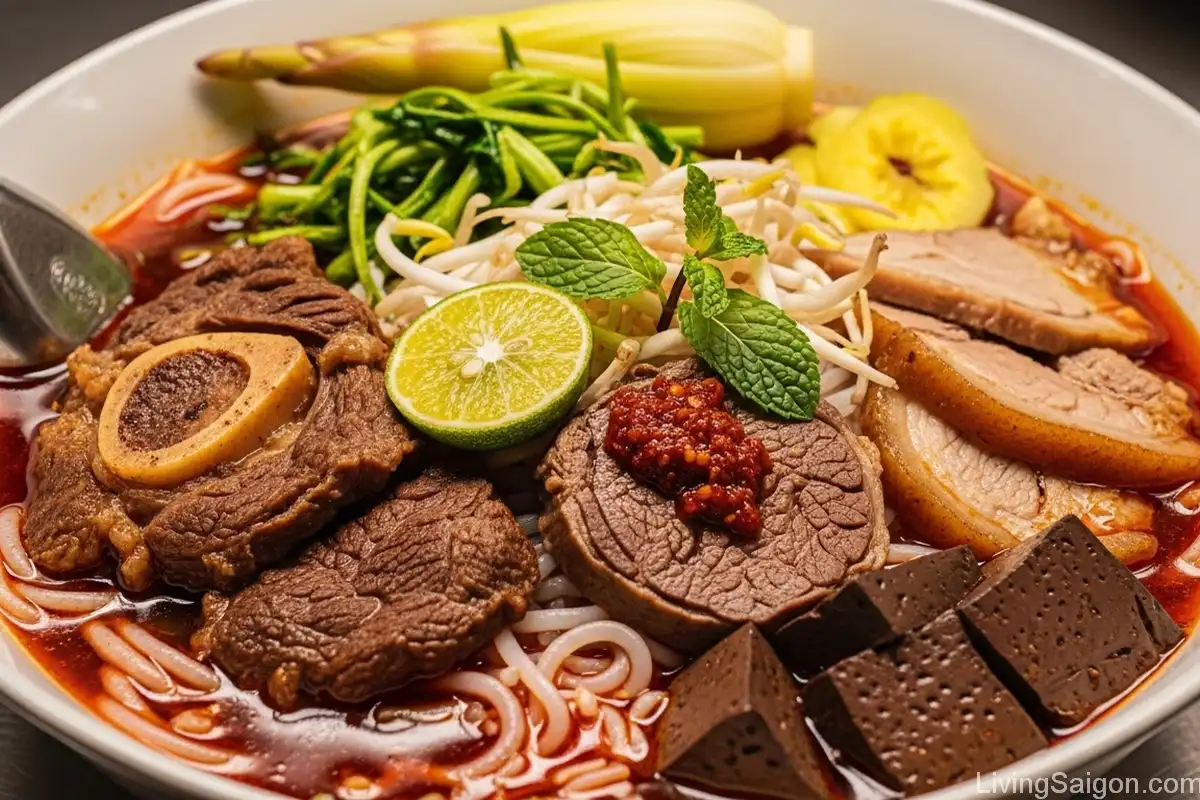
If pho is the internationally famous one, bún bò Huế is the bowl that serious food lovers in Saigon gravitate toward. Originating in the old imperial city of Hue but now deeply embedded in the southern street food scene, it’s a spicy, lemongrass-scented beef and pork noodle soup with a broth that’s richer, more complex, and more intensely flavored than pho. The round, thick rice noodles are different in texture. The chili and shrimp paste create a heat and depth that’s genuinely addictive.
The best bún bò spots in Saigon are on residential side streets in Districts 3, 4, and Bình Thạnh — places that have been serving the same recipe to the same neighborhood for a generation. They’re rarely signposted prominently. You find them by following people you see carrying bowls back to their offices at 7am, or by asking a local where they go on weekday mornings.
Bánh Xèo — The Sizzling Pancake
Bánh xèo (the name means “sizzling cake,” a reference to the sound it makes when batter hits the hot pan) is one of the great communal eating experiences of local food in Saigon. A large, turmeric-yellow crepe made from rice flour, coconut milk, and water is fried until crispy in a hot wok or pan, then filled with pork, shrimp, bean sprouts, and sometimes mung beans. You eat it by tearing off a piece, wrapping it in lettuce and fresh herbs, and dipping it into nước chấm — the sweet-sour fish sauce dipping sauce that is present at almost every table in southern Vietnam.
The wrapping and dipping ritual makes bánh xèo an inherently social dish — it’s hard to eat quickly, which is the point. It appears at family tables, at neighborhood restaurants that fill up on weekend afternoons, and at street stalls where the cook works over a row of identical pans, each one sizzling simultaneously. It’s messy, interactive, and completely delicious.

Cơm Tấm — The Everyday Plate
Cơm tấm (broken rice) is what a significant portion of working Saigon eats for lunch, and it will become part of your own routine within weeks. The broken rice — originally a by-product of the milling process that was sold cheaply to the poor and has since become a beloved culinary institution — is served with a combination of items that typically includes sườn nướng (grilled pork chop), chả trứng (steamed egg cake), bì (shredded pork skin mixed with toasted rice powder), a fried egg, and a small bowl of clear broth for sipping. The components arrive on a single plate and are meant to be eaten together.
The quality of a com tam stall comes down to the charcoal grill. A charcoal-grilled pork chop, properly marinated and cooked over real coals rather than a gas burner, has a caramelized exterior and tender interior that no other method replicates. Look for the grill out front, the smell of charcoal and soy-based marinade, and a line of construction workers or office staff eating on their lunch break. Those are the places worth sitting down at.
Where to Find the Best Local Food in Saigon
Neighborhood Wet Markets: The Source
Everything that ends up in Saigon’s best street food kitchens passes through a wet market first. The neighborhood markets — Tân Định in District 3, Bình Tây in Chợ Lớn, Văn Thánh in Bình Thạnh — operate from the early hours of the morning and are where the city’s home cooks and street food vendors source their ingredients. Fresh herbs arrive daily. Seafood comes alive and kicking. The produce section changes with the season in ways that supermarket equivalents don’t.
Visiting a wet market — even if you’re not buying anything — gives you a completely different understanding of how Saigon’s food system works. The scale, the freshness, the specialization (one vendor for herbs, another for root vegetables, another for dried goods), and the speed of the operation are remarkable. Markets are busiest between 5:30am and 9am; by 10am, the best produce is usually gone. Our guide to the local food guide for Saigon includes a neighborhood-by-neighborhood map of the best markets and the street food that surrounds each one.
The Best Streets and Alleys for Local Food
The most productive strategy for finding great local food in Saigon is to walk the residential streets in the inner districts and pay attention to where people are eating. High foot traffic at a stall or table, visible cooking activity, and the presence of people in work clothes (not tourists) are the reliable indicators. Some streets have developed consistent reputations worth knowing.
Pham Viet Chanh in Bình Thạnh is one of the city’s better-known eating streets — a row of restaurants and stalls that attract a mix of local workers, expats, and people who’ve heard about it. It’s more organized and easier to navigate than the hidden alley spots, but the quality is genuine. The streets around Văn Thánh Market in Bình Thạnh are similarly worth exploring on foot in the early morning. In District 4, the seafood restaurants that line the streets closest to the old port have been there for decades and produce some of the freshest grilled seafood in the city.

Chợ Lớn — The Chinatown Food District
Chợ Lớn, Saigon’s Chinatown, occupies Districts 5 and 6 and represents one of the richest and most distinct food environments in the city. The Chinese-Vietnamese community that settled here centuries ago brought their culinary traditions with them, and the result is a food scene that overlaps with but is genuinely different from the Vietnamese mainstream. Dim sum, roast duck, congee stalls, hand-pulled noodles, traditional Chinese medicinal soups, and pastry shops selling egg tarts and pineapple buns coexist with Vietnamese com tam stalls and pho shops on the same streets.
The Bình Tây Market is the anchor of the Chợ Lớn food experience — a massive covered market that operates on a scale that’s genuinely staggering if you haven’t seen it before. The food stalls surrounding the market perimeter are worth as much attention as the market itself. This is one of the most authentic and rewarding food districts in the city, and one that most expats don’t explore until they’ve been here for a year or more. For hidden gems and specific recommendations in this area, our article on hidden food spots in Saigon covers Chợ Lớn in detail.
Eating Local Food in Saigon: The Rules That Aren’t Rules
There are some practical principles that experienced Saigon eaters apply, worth knowing before you start exploring.
Follow the turnover. High-volume stalls cook constantly and use fresh ingredients constantly. A pho shop that serves fifty bowls before 8am is cooking fresher and better than one that serves ten. Turnover is a proxy for quality in street food, and it’s almost never wrong.
Eat early. The best local food in Saigon is a morning activity. The city’s most celebrated street food spots have sold out by noon, sometimes earlier. If you’re serious about eating well, get up at 6:30am and go find breakfast. This is not a hardship — Saigon is beautiful in the early morning before the heat builds, and the food rewards are genuine.
Order what others are ordering. If you sit down at a stall and don’t know what to order, look at what the people already eating have. Point at it. This works more reliably than trying to navigate a menu you can’t read, and it typically gets you the specialty rather than the safe option.
Learn a handful of Vietnamese food names. You don’t need to be fluent. Knowing the names of five or six dishes — pho, com tam, bun bo, banh mi, bun rieu — and being able to say them in a way that’s approximately correct makes ordering dramatically easier and earns genuine goodwill. The Vietnamese food in Saigon guide covers the essential dishes with pronunciation notes.
Don’t fear the plastic stool. The lowest, most uncomfortable-looking plastic furniture in Saigon is usually found outside the best food. This is not a coincidence. High-end furniture is expensive; great broth and forty years of practice are what a neighborhood food shop invests in. The stool is fine. Sit down.
Local Food in Saigon by Meal and Time of Day
Local Breakfast in Saigon
Breakfast in Saigon is eaten early and eaten out. The city’s workers are at their morning food spots between 5:30am and 8am, and the best stalls have sold out and are cleaning up by 9 or 10. Pho, bún bò Huế, bánh mì, cháo (rice congee), and xôi (sticky rice with various toppings) are the main breakfast formats. Cà phê sữa đá — iced coffee with condensed milk — is the universal accompaniment, available from street carts at 15,000 VND ($0.60) or from cafes at several times that price.
The best breakfast experience in Saigon is simple: pick a district, walk until you find a stall with a line, sit down, order what the person next to you is eating, and drink the coffee. You will not be disappointed. For a curated guide to specific spots by neighborhood, our article on local breakfast in Saigon breaks it down district by district.
Lunch: The Cơm Trưa Culture
Lunch in Saigon — cơm trưa, the midday rice — is a serious business. Between noon and 1:30pm, the streets around any commercial area fill with people eating at outdoor tables, at plastic stools on the pavement, and at the ground-floor restaurants that operate only for the lunch rush. Cơm tấm is the dominant format, but the “cơm bình dân” category — simple rice plates with a rotating selection of proteins, vegetables, and soups — is where a huge amount of the city eats. A full plate with two or three components costs 40,000–60,000 VND ($1.75–2.50) at a good local spot.
The lunch rush is also a window into how the city works. The density of people eating together in the streets, the speed of service, the casual social mixing — it’s one of the most genuinely communal experiences in Vietnamese urban life, and participating in it, even as a foreign observer, is part of understanding the city.

Street Food After Dark
The evening street food scene is different in character from the morning and lunch rush — slower, more social, with a wider range of formats. Bún thịt nướng (vermicelli with grilled pork), bánh xèo, lẩu (hot pot) at communal tables, grilled seafood at District 4 restaurants, and the various che (sweet dessert soups) sold from carts that appear after 6pm — the evening street food experience rewards wandering in a way that the more purpose-driven morning eating doesn’t.
Night markets in several districts operate on weekends — the area around Bến Thành Market has a dedicated night market zone, and various neighborhoods organize their own versions. These lean more tourist-facing in the most central areas but are genuinely local in the residential districts. For a full guide to what’s happening after dark — from street food to the broader nightlife scene — the best cafes in Saigon guide and the must-try food in Saigon list both cover evening options in depth. And if you want to explore the city’s eating scene with a local guide who knows where to go at each time of day, our guide to cheap local food in Saigon covers how to eat extremely well without spending much.
The local food scene in Saigon is inexhaustible. You can eat here for years and keep discovering things — a stall you walked past a hundred times and never noticed, a dish you’d never heard of, a preparation method that makes something familiar entirely new. The city rewards the curious eater more than almost anywhere else in the world. All you need to do is sit down, point at what looks good, and begin.