

Binh Thanh doesn’t have a reputation built on decades of expat infrastructure the way Thao Dien does, and it doesn’t have the master-planned boulevards of District 7. What it has is something arguably more interesting: a district that is genuinely alive, centrally located, more affordable than its neighbors, and currently in the middle of a quiet transformation that’s making it one of the most compelling places in Saigon for a particular kind of expat — independent-minded, food-curious, and willing to trade the comfort of an international bubble for something that feels more like actually living in Vietnam.
This Binh Thanh district guide covers the full picture: the geography and sub-areas, the rental market with current prices, the food and cafe scene that has been quietly building its reputation for years, the transport situation, the landmark developments that define the district’s skyline, and an honest assessment of who Binh Thanh is genuinely right for versus who would be better served somewhere else. For the broader picture of how Binh Thanh fits within the city’s neighborhood landscape, the districts in Saigon overview sets the context.

Understanding Binh Thanh: The District That Contains Multitudes
Binh Thanh is one of the larger inner districts of Ho Chi Minh City by area, and its size means it contains significantly more variety than most guides acknowledge. The district stretches from the Saigon River on its eastern edge — where Vinhomes Central Park and the Landmark 81 tower have created a luxury high-rise enclave — through densely populated local residential streets in its middle sections, to the more creative, independently minded bar and cafe strip along and around Pham Viet Chanh and Dien Bien Phu that has defined the district’s evolving identity for expats over the past decade.
Understanding this internal diversity is the key to understanding Binh Thanh. The Binh Thanh district is not one neighborhood — it’s several overlapping characters occupying the same administrative geography, and the experience of living here depends enormously on which part of the district you’re in and which version of Binh Thanh you’re primarily engaging with.
Vinhomes Central Park and Landmark 81: The Premium Enclave
The most visible face of Binh Thanh to anyone approaching from the Saigon River is Landmark 81 — at 461 meters, currently the tallest building in Vietnam and one of the most recognizable skyline elements in the city. It anchors the Vinhomes Central Park development, a large integrated residential-commercial-retail complex that represents the premium end of Binh Thanh’s property market.
Living in Vinhomes Central Park is an experience unto itself: a high-rise lifestyle with views that on clear days extend across the entire city, access to an extensive park and riverside promenade, internal retail and dining, and the kind of resort-style amenity package that includes multiple pools, gyms, and twenty-four-hour concierge service. The prices reflect the position — 1-bedroom apartments in the better Vinhomes towers run $1,000–$1,800/month, putting this zone at the premium end of the Binh Thanh market and comparable to Thao Dien pricing for equivalent quality.
For expats whose priority is a spectacular apartment in a well-managed development with maximum amenities, and who want the Binh Thanh address and its proximity to District 1 without the local Vietnamese character of the district’s interior, Vinhomes offers exactly this. It is, however, not the most representative experience of what makes Binh Thanh interesting — that’s found in the streets further from the river.
The Creative Strip: Pham Viet Chanh and Dien Bien Phu
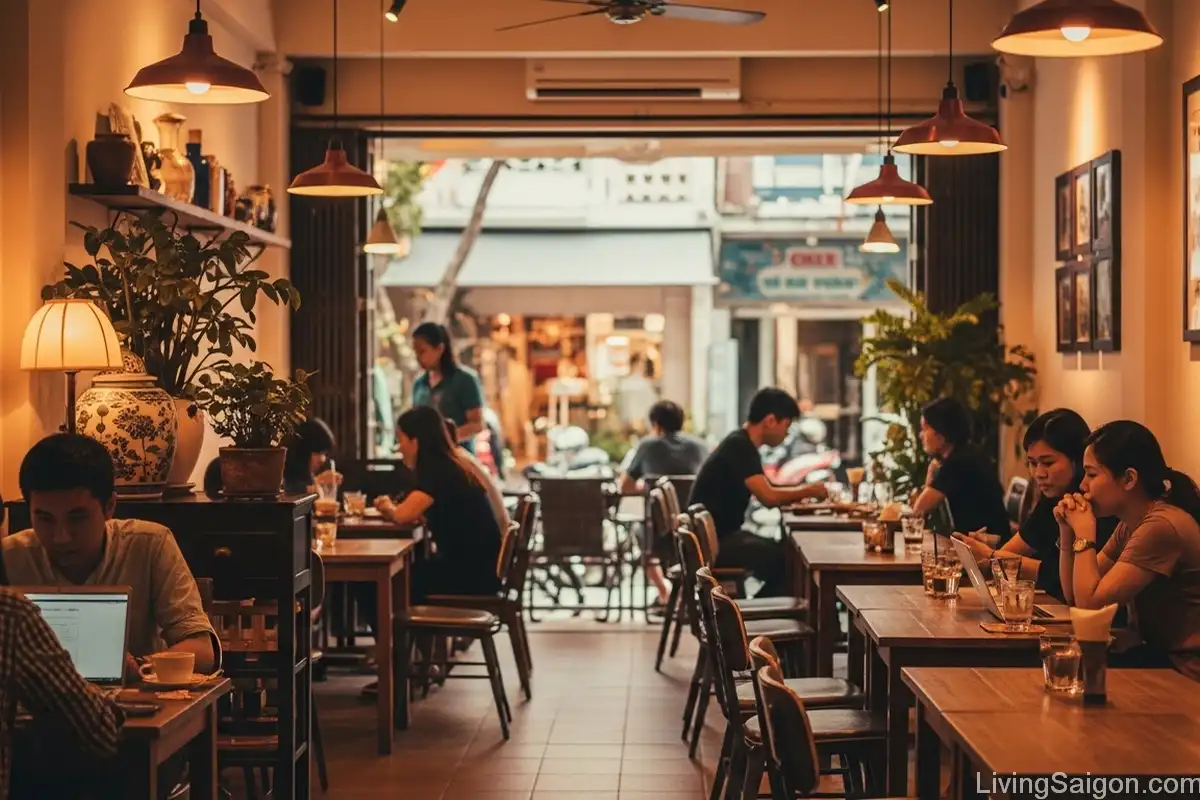
The most talked-about part of Binh Thanh among expats and Saigon’s young creative community is the strip of streets and laneways centered on Pham Viet Chanh and the sections of Dien Bien Phu between it and the city center boundary. This area has developed organically over the past several years into one of the most interesting eating and drinking environments in Saigon — a mix of Japanese izakayas, craft beer bars, independent cafes, Vietnamese restaurants that have opened specifically to serve the neighborhood’s growing expat and creative professional population, and a scattering of boutique guesthouses that have discovered Binh Thanh’s location advantage.
The character here is genuinely different from the tourist-facing areas of District 1 and the settled suburban feel of Thao Dien. The bars and cafes along this strip have a more independent, less commercially polished character — they’re places that feel like they were opened by someone who wanted to run exactly that place, not places designed by committee to maximize table turns. The food quality is high and the prices are significantly lower than equivalent establishments in District 1 or Thao Dien.
The Local Interior: Vietnamese Residential Binh Thanh
Beyond the premium riverside development and the creative strip, the bulk of Binh Thanh is Vietnamese residential urban fabric — the kind of dense, layered, multi-generational streetscape that defines the inner-city experience of most of Saigon. Markets operate in the early morning hours. Street food stalls set up on the pavements from 6am and again in the evening. Motorbike repair shops, local hairdressers, and traditional medicine shops share streets with Vietnamese cafes and family restaurants that have been in the same location for decades.
For expats who want daily immersion in Vietnamese urban life — who want to be a regular at a neighborhood pho shop, who want to buy their vegetables from the woman who sets up a stall outside their building every morning, who want their Vietnamese to improve through necessity rather than choice — this version of Binh Thanh is exactly what they’re looking for. For expats who need reliable English-language service environments, expat community infrastructure, and international school logistics, it requires more independence to navigate.
Binh Thanh District Guide: Apartments and Rent
The rental market in Binh Thanh is one of the district’s most compelling practical advantages for expats who want central Saigon proximity without the premium pricing of the more established expat enclaves. The price-to-location ratio in Binh Thanh is genuinely among the best in the city — you’re paying less than Thao Dien prices while being closer to District 1 geographically.
Current Rent Ranges
The range in Binh Thanh is wide, reflecting the district’s internal diversity. At the budget end, older studio apartments and small 1-bedrooms in Vietnamese residential buildings outside the main expat-facing zones start from $350–$500/month. These require more comfort with local living conditions — older plumbing, Vietnamese-speaking building management, minimal amenity packages — but represent genuine value for expats who prioritize location over luxury.
Mid-range 1-bedroom apartments in newer buildings with basic amenities — security, elevator, some with small gym or pool — run $550–$800/month in the Pham Viet Chanh and Dien Bien Phu area, and $600–$850/month in buildings along the main roads connecting to District 1. These buildings cater to a mixed Vietnamese and expat market, and the landlord communication is typically accessible in some English.
Premium 1-bedrooms and 2-bedrooms in the better mid-range and high-end buildings outside the Vinhomes complex run $800–$1,300/month. The Vinhomes towers themselves command $1,000–$1,800+/month for 1-bedrooms depending on floor and view. The overall market in Binh Thanh therefore spans an unusually wide range — from genuine budget options to genuine luxury — all within the same administrative district.

What Makes Binh Thanh Good Value
The key calculation for Binh Thanh’s value proposition: a good mid-range 1-bedroom here typically costs $150–$250/month less than a comparable apartment in Thao Dien, while being actually closer to District 1 by road distance. A couple saving $200/month on rent over twelve months recovers $2,400 — money that can fund several regional trips, a year of gym membership, or a substantially improved food and social budget. The compound effect of this saving over a two-year expat posting is meaningful.
The trade-off is the expat community infrastructure. Binh Thanh doesn’t have the density of international school access, the Saturday farmers market, the organized expat sports clubs, and the deep social network that Thao Dien has developed over decades. For expats who’ve lived in Saigon long enough to have established their own social life and don’t need the scaffolding that a developed expat enclave provides, this trade-off is entirely acceptable. For new arrivals looking to build a social network quickly from scratch, it’s a genuine consideration. Our article on cheap apartments in Binh Thanh provides current listings and a neighborhood-by-neighborhood breakdown of where in the district to look for different budget levels.
Food in Binh Thanh: A Serious Scene
The food scene is one of the strongest arguments for the Binh Thanh district as a place to live, and it deserves more attention than it typically gets in guides that focus on the established expat food hubs of Thao Dien and District 1.
Local Street Food
Binh Thanh has some of the best street food access in the city at the neighborhood level. The wet markets — particularly Van Thanh Market near the Saigon Bridge and the smaller neighborhood markets scattered through the district’s residential interior — are early-morning institutions where the city’s best produce, fresh herbs, live seafood, and local ingredients flow through before most of the city has woken up. The breakfast stalls that set up around these markets serve some of the most consistent and authentic local food in the inner city: pho shops that have been there for thirty years, bun bo Hue vendors who do a brisk trade from 6:30am until they sell out around 10am, banh mi carts that maintain the same recipe their families have used for decades.
The evening street food culture in Binh Thanh is particularly strong. The residential streets come alive after 6pm with grilled skewer stalls, com tam shops that stay open until midnight, and the various sweet dessert sellers — che, banh, and various Vietnamese street sweets — that are a feature of Saigon evenings in the local neighborhoods. Eating well in Binh Thanh for $3–5 USD per meal is entirely practical, and the quality at the neighborhood’s best local spots is genuinely excellent. Our guide to food in Binh Thanh covers the specific streets and stalls worth knowing about for each meal type and time of day.

The Independent Bar and Cafe Scene
The strip along Pham Viet Chanh and the connecting streets has developed a reputation among food writers and restaurant guides as one of the most interesting eating and drinking corridors in Saigon — and this reputation is deserved. The concentration of Japanese izakayas along this stretch is remarkable: small, counter-service establishments with meticulous Japanese food and a neighborhood-bar atmosphere that Japanese expats and food-serious Saigon locals have made into genuinely excellent venues. Several craft beer bars along the same strip serve Vietnamese and international craft beers in settings that attract a young, mixed Vietnamese and expat crowd.
Beyond the eating and drinking establishments, Binh Thanh has developed a significant cafe culture of its own. The cafes here don’t have the Instagram-optimized aesthetics of the Thao Dien options, but many of them are better for actually spending time in — quieter, less crowded, with better coffee and more reliable wifi. Several specialty roasters and coffee labs have established themselves in the district, and the Vietnamese iced coffee culture continues at the neighborhood level with street cart vendors offering cà phê sữa đá at prices that haven’t changed much in years. For a deeper dive into the best places to sit with a coffee in this part of the city, the food in Saigon guide covers Binh Thanh’s cafe scene alongside the city’s wider dining landscape.
Local Food and the City’s Best-Value Eating
One dimension of the Binh Thanh food scene that deserves specific mention is the local food in Saigon dimension of the district. Binh Thanh is one of the districts where Vietnamese local food culture is most intact and most accessible — the kind of neighborhood where a long-term resident can develop genuine relationships with specific vendors, where the woman who makes your morning banh mi eventually knows what you want before you order, and where eating locally feels like participation rather than tourism. This texture of daily life is genuinely difficult to find in the more expat-curated environments of Thao Dien or District 7, and for a certain kind of expat it’s one of the defining qualities of living in Binh Thanh.
Getting Around: Binh Thanh’s Location Advantage
The Binh Thanh district’s location is one of its most underappreciated advantages. The district is adjacent to District 1 — in its northwestern corner, the two districts share a boundary — which means that for many addresses in Binh Thanh, the commute to the city center is genuinely short: ten to twenty minutes by motorbike or Grab during off-peak hours, and rarely more than thirty minutes even in traffic.
The contrast with Thao Dien is meaningful here. A Thao Dien resident commuting to District 1 faces twenty-five to forty-five minutes most days, with the tunnel or bridge approach roads creating predictable congestion during rush hours. A Binh Thanh resident in the western part of the district can cross into District 3 or District 1 in fifteen minutes on a motorbike with no tunnel required. The geography here is simply more favorable for people whose daily lives involve regular trips to the city center.
The Pham Viet Chanh Advantage
The streets around Pham Viet Chanh sit in the part of Binh Thanh that provides the most direct access to District 1 — a short ride along Dien Bien Phu or Phan Dinh Phung reaches the heart of the center without navigating major chokepoints. For expats who work in or near the CBD, this access pattern makes Binh Thanh considerably more practical than the east-bank neighborhoods despite its lower rent. The morning motorbike commute from this part of Binh Thanh to a District 1 office is genuinely pleasant by Saigon standards — fast, direct, and requiring none of the tunnel congestion management that District 2 commuters deal with daily.
Grab and the Motorbike Question
Grab availability is excellent in Binh Thanh at virtually all hours, reflecting the district’s density and central position. The pricing is comparable to other inner districts — a trip to District 1 by GrabCar runs $3–5 during off-peak, slightly more during the rush. The motorbike question is worth addressing directly: Binh Thanh is one of the districts where motorbike ownership makes the most difference to quality of life. The density of the district’s street network and the multiple route options to the center mean that a motorbike-owning Binh Thanh resident can navigate around traffic in ways that no four-wheeled vehicle manages, and the time savings are real and consistent. Many long-term Binh Thanh expats cite their motorbike as the single best investment they made in their Saigon life.
The Developing Expat Scene in Binh Thanh
Binh Thanh’s expat community is younger and less established than Thao Dien’s, which shapes its character in ways that are either an advantage or a disadvantage depending on your personality and priorities. The Facebook groups are active and growing; the WhatsApp networks less organized but present; the social life centered more on the bars, cafes, and restaurants of the creative strip than on organized school-community events or structured social clubs.
The demographic skews younger — more digital nomads, more remote workers, more people on their first or second Southeast Asia posting who are interested in genuine cultural immersion rather than a comfortable international enclave. There’s a creative professional contingent: designers, writers, photographers, developers, and the various creative freelancers that Saigon’s low cost of living and cultural energy attracts from across the world. The energy here is more improvisational and independent than the organized community life of Thao Dien or District 7.
The practical implication for someone considering Binh Thanh: if you arrive with existing social connections in Saigon, or if you’re comfortable building a social life through the bar and cafe culture of the creative strip rather than through the organized expat community infrastructure, Binh Thanh works very well. If you’re arriving completely alone and need a quick, organized, family-oriented community to plug into, Thao Dien will solve that problem faster. The guide to expat life in Binh Thanh covers the social landscape in more detail, including which Facebook groups are most active, which community events run regularly, and what the annual social calendar looks like for the district’s expat population.
Things to Do and Explore in Binh Thanh
The district’s position adjacent to District 1 means that access to the city’s main cultural and entertainment infrastructure is excellent — the major museums, the Opera House, the rooftop bar scene, and the District 1 restaurant strip are all within a short trip. But Binh Thanh also has its own internal points of interest that reward exploration.
Van Thanh Tourist Area and the River
The Van Thanh Tourist Area, in the district’s eastern section along the river, is a local recreation zone that operates primarily for Vietnamese families and domestic tourists but is genuinely pleasant for expat residents who discover it. Boat trips along the canals, weekend food and craft markets, and the relative greenery of the riverside space provide a relief valve from the urban density of the district’s interior. It’s not an internationally curated experience, but that’s partly the point.
The Street Art and Creative Infrastructure
Binh Thanh has developed a modest but growing street art scene over the past several years, concentrated in the laneways and walls of the creative strip area. The murals and installations that have appeared on building facades along Nguyen Huu Canh and adjacent streets give the area a visual energy that’s distinctly its own. Several creative studios, photography collectives, and design agencies have established themselves in the district’s converted warehouse and shophouse spaces, which adds a creative professional dimension to the neighborhood character that contributes to its distinctiveness. For a guide to what’s happening in the district beyond just eating and sleeping, our article on things to do in Binh Thanh covers the full range of activities, from weekend markets to cultural events to day-to-day neighborhood exploration.
Binh Thanh District Guide: Who It Suits
The honest answer to who the Binh Thanh district guide is most relevant for comes down to a particular expat profile that is different from the typical Thao Dien or District 7 candidate.

Binh Thanh Works Best For:
Digital nomads and remote workers who want central proximity, good cafe infrastructure, and lower rent than Thao Dien — and who don’t need the family school infrastructure that drives the east bank’s premium pricing. Singles and couples without children who want to experience genuine Vietnamese city life alongside their expat social circle, rather than primarily within an international bubble. People who’ve lived in Saigon before, understand how the city works, and have moved past the stage of needing maximum expat community scaffolding. Budget-conscious expats at any stage who recognize that the $150–$300/month rent saving relative to Thao Dien is meaningful over the course of a one or two-year posting. People who commute regularly to District 1 and want to minimize that commute rather than manage it.
Binh Thanh Is Less Suited For:
Families with children in Thao Dien or District 2 international schools, where the commute against traffic from Binh Thanh to the school zone would be significant. New arrivals who need the organized social infrastructure of a well-established expat community to build their initial social network in the city. People who genuinely prefer the spaciousness, planning, and suburban order of District 7 over the organic density of a Vietnamese inner-city neighborhood.
The where to live in Saigon guide gives the most comprehensive comparison of Binh Thanh against every other major expat neighborhood — essential reading if you’re still weighing your options. The cost of living in Saigon guide provides the budget context that helps quantify the financial dimension of the choice. And when you’re ready to start the apartment search in Binh Thanh specifically, our guide to cheap apartments in Binh Thanh gives you the granular, current information you need to navigate the market effectively.

Binh Thanh is the district that rewards the expat who approaches Saigon with curiosity rather than with a checklist of required amenities. It’s noisier, more local, less organized, and more alive than the neighborhoods that get most of the international attention — and for a growing number of people who’ve spent time in the city, that’s precisely what makes it the right place to be.