
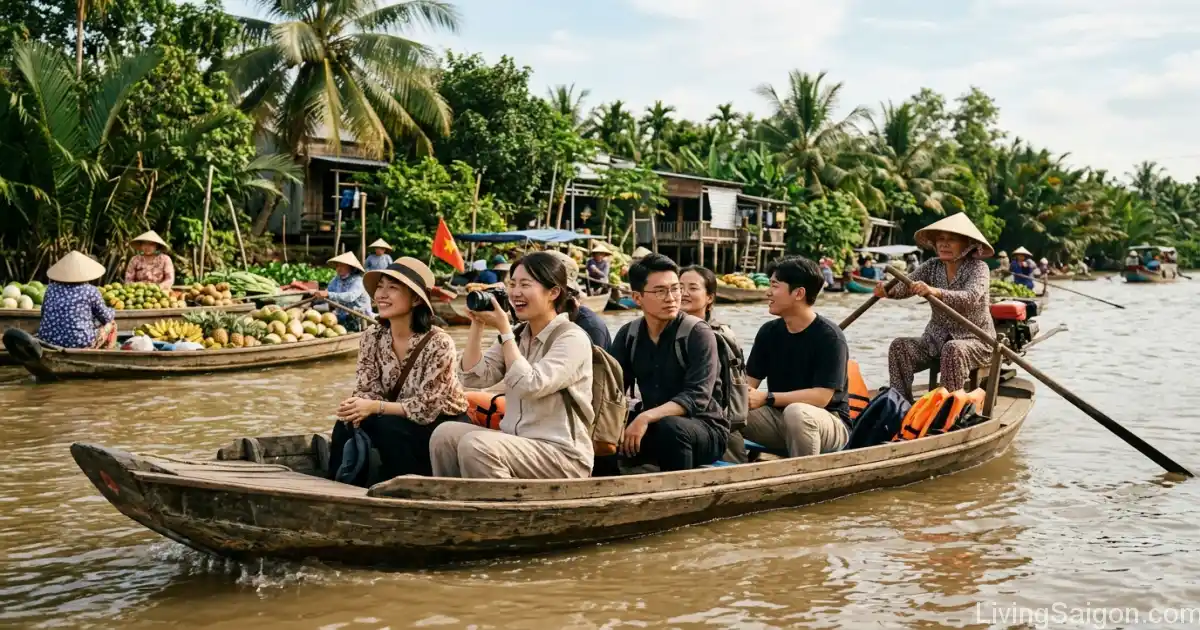
Saigon rewards extended stays, but the city’s position in the southern Vietnamese lowlands makes it one of the best-located bases in Southeast Asia for day excursions. Within a two-hour radius — the practical limit for a rewarding day trip that allows reasonable time at the destination — lie the river delta of the Mekong, the most famous underground military installation of the Vietnam War, a working beach resort that has served the city’s residents for over a century, the spiritual headquarters of one of Vietnam’s most distinctive homegrown religions, and stretches of genuine countryside that provide complete contrast to the urban intensity of the city itself.
This guide covers the essential day trips from Saigon — what each destination is, how to get there, what to expect when you arrive, and how to make the most of a single day away from the city. For visitors who want to explore the city’s own attractions before venturing further, the landmarks in Saigon guide and the cultural sites in Saigon guide cover the in-city options. For the museum dimension of Saigon’s own historical landscape that provides context for destinations like Cu Chi, the museums in Saigon guide is the right starting point.

The Mekong Delta: The Essential Day Trip from Saigon
The Mekong Delta is the single most important day trip from Saigon for anyone who wants to understand the city’s relationship with its hinterland and the broader ecology of southern Vietnam. The delta — formed by the Mekong River as it fans out into nine distributary channels (the “Nine Dragons” of the Vietnamese name, Cửu Long) before reaching the South China Sea — is one of the world’s great river delta systems: a vast, flat, intensely farmed and populated landscape of rice paddies, fruit orchards, floating markets, river towns, and waterway networks that sustains roughly twenty million people and produces a significant portion of Vietnam’s agricultural output.
What the Mekong Delta Experience Involves
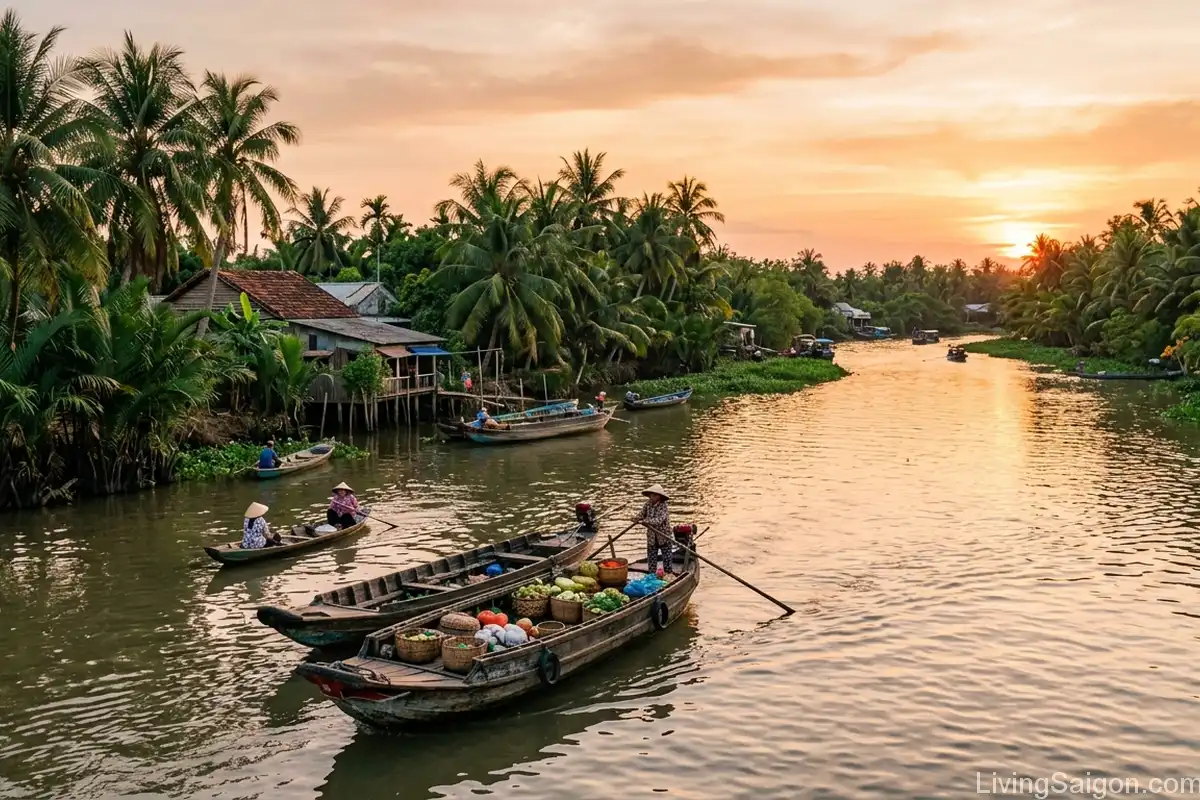
The day trip experience of the Mekong Delta typically centers on the provincial towns of Mỹ Tho (approximately ninety minutes from Saigon by road) or Bến Tre (slightly further), both accessible as day-trip destinations. From these bases, the classic experience involves boat trips on the delta’s waterway network — narrow wooden vessels navigating channels lined with overhanging vegetation, stopping at river islands for visits to coconut candy factories, honey bee farms, orchid gardens, and local fruit orchards where seasonal tropical fruits are served alongside Vietnamese herbal tea.
The more authentic encounter involves the early-morning floating markets, where wholesale produce trading happens from boat to boat on the river in the pre-dawn hours — Cái Bè floating market is the most accessible to Saigon day-trippers, though the floating market experience is increasingly tourist-facing rather than purely commercial. For visitors primarily interested in the genuine agricultural landscape rather than the tourist infrastructure, arranging a private boat with a local guide to explore the smaller channels away from the main tourist routes produces a dramatically more interesting day.
Getting to the Mekong Delta
The most common approach is a guided day tour from Saigon, which handles the logistics of transport, boat arrangements, and English-language interpretation — typically running $25–45 per person depending on quality level and group size. For independent travelers, buses to Mỹ Tho from the Mien Tay bus station operate frequently (approximately 90 minutes, 60,000–80,000 VND) and local boat operators at the riverfront can arrange delta excursions. Our dedicated guide to the Mekong Delta from Saigon covers the current logistics, best tour operators, and what to do independently in detail.
Cu Chi Tunnels: The Underground War
The Cu Chi Tunnels are the most visited historical site near Saigon, and for good reason — they represent one of the most remarkable feats of military engineering and human endurance documented anywhere in the twentieth century. During the Vietnam War, the Viet Cong guerrillas who operated in the Cu Chi district northwest of Saigon constructed an underground tunnel network that eventually extended to approximately 250 kilometers of passages, spanning multiple levels and including living quarters, kitchens, hospitals, weapons workshops, and command centers — all hidden beneath the surface of a landscape that American forces were simultaneously bombing from above.
What to Expect at Cu Chi
There are two main Cu Chi tunnel sites open to visitors: Ben Duoc (the more remote and less touristic site, approximately 70 kilometers from the city) and Ben Dinh (closer, more developed for tourism, and the one most day tours visit). Both sites offer the experience of crawling through a section of tunnel that has been widened slightly from its original dimensions to accommodate Western-sized visitors — the original tunnels were designed for people significantly smaller than the average European or American frame, which itself communicates something significant about the physical reality of the guerrilla fighters who used them.
Above ground, the sites display American military equipment — tanks, planes, and unexploded ordnance — alongside exhibits documenting the tunnel construction, the daily life of tunnel inhabitants, and the military operations conducted from the underground network. A firing range allows visitors to fire AK-47s and M16s, which is controversial but consistently popular. The exhibit on the booby traps used against American patrols — recreated but non-functional versions of the spring-loaded bamboo and metal spike devices — is sobering and provides a visceral sense of the asymmetric warfare tactics employed by the Viet Cong.
The full Cu Chi experience, with time for crawling through the tunnels, the outdoor exhibits, and the documentary film, takes approximately three hours at a comfortable pace. For the detailed visiting guide including current admission prices, the difference between Ben Duoc and Ben Dinh, and how to arrange independent transport, our article on the Cu Chi Tunnels covers everything you need.

Getting to Cu Chi
Cu Chi is approximately 70 kilometers from central Saigon by road — roughly ninety minutes by car in light traffic, up to two and a half hours in heavy traffic. Guided tours from the city are the most efficient approach, typically priced at $15–35 per person including transport and entrance fees. Independent travelers can reach the Ben Dinh site by bus from the An Suong bus station (approximately 10,000–15,000 VND to Cu Chi town, then motorbike taxi to the site). The Ben Duoc site requires a car or motorbike as it’s not served by local bus routes that day-trippers can easily navigate.
Vung Tau: Saigon’s Beach Town
Vung Tau has served as Saigon’s seaside escape for over a century — first for French colonial administrators, then for American military personnel during the war years, and now for the city’s Vietnamese middle class, expat community, and international visitors who want a beach day within reach of the city. The town occupies a small peninsula approximately 125 kilometers southeast of Saigon, easily reached by speedboat or road, and offers a complete change of environment from the urban intensity of the city: seafood restaurants, beach promenades, a colonial-era lighthouse, and the famous 28-meter statue of Christ (a near-contemporary of Christ the Redeemer in Rio) overlooking the South China Sea from the peninsula’s highest hill.
The Vung Tau Experience
The beaches of Vung Tau — Front Beach (Bai Truoc) and Back Beach (Bai Sau) — are the primary draw, though their quality relative to the beaches of further destinations (Mui Ne, Phu Quoc, Da Nang) should be acknowledged honestly: they are comfortable and well-served, with beachside restaurants, rental umbrellas and sunloungers, and the general amenity of a well-developed resort town, but they are not the pristine white-sand beaches of a remote tropical destination. The water quality is reasonable, the seafood is excellent, and the atmosphere — particularly on weekday visits when the city crowds are absent — is genuinely relaxing.
The seafood restaurants along the waterfront are one of Vung Tau’s strongest assets. Fresh catch brought in daily from the South China Sea, prepared simply — grilled, steamed, or fried with garlic and chili — at prices that are significantly more favorable than equivalent quality in the city. A full seafood lunch for two with cold Saigon beer is one of the most satisfying daytime experiences the Vung Tau trip offers.

Getting to Vung Tau
The speedboat from the Bach Dang pier in District 1 is the most popular option — approximately 80 minutes to Vung Tau, with services running multiple times daily. The boat journey down the Saigon River through the industrial port zone and then across the open water provides its own scenic dimension. High-speed bus services are also available and slightly cheaper (roughly 100–130km by road, 2–3 hours). Return boats or buses run until late afternoon — plan to be at the pier by 5pm for the last reliable departure. Our complete guide to the Vung Tau day trip from Saigon covers transport options, the best beaches by time of year, and seafood restaurant recommendations.
Tay Ninh and the Cao Dai Holy See
Tay Ninh province, approximately 96 kilometers northwest of Saigon near the Cambodian border, is the spiritual home of Cao Daism — one of the world’s most visually extraordinary religions and one of the few genuinely Vietnamese-origin world religions. The Cao Dai Holy See in Tay Ninh city is the religion’s Vatican — its administrative and spiritual center — and the Great Temple at its heart is among the most spectacular religious buildings in Southeast Asia: an explosion of color, symbolism, and architectural eclecticism that blends European, Asian, and purely Cao Dai elements into something entirely unique.
The noon prayer ceremony (12pm daily) is the most accessible for day-trippers and involves several hundred worshippers in the distinctive white, blue, and red robes of the three main Cao Dai branches filing into the cathedral to pray — an extraordinarily visual and genuinely moving ritual that operates entirely independently of tourism while being open to respectful visitors in the gallery above the main nave. The combination of Tay Ninh with Cu Chi on the same day is a natural pairing — both are in the same general direction from the city and can be combined into a single longer day trip. Our guide to the best places near Saigon covers Tay Ninh and other lesser-visited destinations in the surrounding provinces.
The Saigon River and Canal Tours
Not all day trips from Saigon require leaving the metropolitan area. The Saigon River and its network of canals offer a different perspective on the city and its immediate surroundings that is entirely inaccessible by road. Evening cruises on the Saigon River — departing from the Ben Nghe canal jetty near the city center — provide the classic sunset-over-skyline experience. More interesting for longer explorations are the canal tours that penetrate into the older, less-developed waterway networks southeast of the city, where traditional river life continues in forms that have largely disappeared from the main river and from the city streets.

The full-day river excursion to Can Gio — the mangrove biosphere reserve at the Saigon River mouth, approximately two hours by boat from the city center — is one of the most distinctive and least-crowded day trip from Saigon options. Can Gio’s mangrove forest, replanted after the extensive defoliation of the Vietnam War and now a UNESCO Biosphere Reserve, is home to macaque troops, monitor lizards, migratory birds, and the distinctive ecosystem of an intact mangrove delta. The combination of wildlife, landscape, and the boat journey itself makes Can Gio one of the most genuinely different experiences accessible on a Saigon day trip.
Day Trips from Saigon: Planning and Practical Information
Several practical considerations shape the planning of day trips from Saigon and make the difference between an efficient, enjoyable day and a frustrating one dominated by transport logistics.
Best Times for Day Trips
The dry season (November to April) is the optimal period for day trips in terms of weather — clear skies, lower humidity, and no afternoon downpours make outdoor sites like the Mekong Delta and Vung Tau significantly more pleasant. The wet season (May to October) brings afternoon rain to most destinations, though the mornings are typically clear. The Mekong Delta is actually most interesting in the wet season when the river levels are highest and the waterways most navigable — the flooding that affects the delta in August and September, while disruptive for local residents, creates a landscape of unusual beauty for boat-based exploration.
Guided Tours Versus Independent Travel
The honest assessment: for most day trips from Saigon, a well-chosen guided tour offers significantly better value than independent travel for first-time visitors. The logistics of transport, entrance fees, boat arrangements, and English-language interpretation at historical sites like Cu Chi add up quickly, and the time spent on logistics reduces the time available at the destination. Quality guided tours — particularly private tours rather than large group buses — handle all of this for a total cost that is often comparable to what independent travel costs once transport, entrance, and incidental expenses are totaled.
For repeat visitors who know the routes and are comfortable navigating Vietnamese transport independently, the bus-and-local-guide approach for the Mekong Delta and public transport to Vung Tau by speedboat are both practical and more affordable. The Cu Chi Tunnels specifically benefit from guided interpretation — the historical and tactical context that a knowledgeable guide provides makes the underground experience significantly more meaningful than self-guided exploration.
Transport Options Summary
The transport landscape for day trips from Saigon includes private car hire (most comfortable and flexible, typically $60–120 for a full-day private vehicle), guided tour buses (comfortable, typically $15–45 per person including most costs), speedboat to Vung Tau ($15–25 each way from Bach Dang pier), and public buses to various provincial destinations from Saigon’s major bus stations. For visitors arriving in Saigon and needing airport-to-hotel or hotel-to-departure transfers around day trip planning, our airport transfer in Saigon guide covers the options for starting and ending your time in the city smoothly.
For a guided experience that covers the best of Saigon’s day trip options with professional local knowledge and flexible itinerary design, the Saigon city tour programs include day-excursion options to the Mekong Delta, Cu Chi Tunnels, and Vung Tau — designed to give you the most of a limited day while avoiding the common frustrations of tour-group logistics. The full range of what to see and do both within the city and in the surrounding region can also be explored through our guide to the best places near Saigon, which covers provincial destinations within a two-hour radius in detail.