

Saigon’s cultural identity is one of the most layered and genuinely complicated in Southeast Asia. The city has been, in succession, a Khmer fishing settlement, a Vietnamese imperial outpost, the capital of a French colony, the capital of South Vietnam during a decades-long war, and since 1975 the economic engine of a unified communist state that has spent the last forty years integrating itself into the global economy. Each of these chapters left physical traces on the city that exist simultaneously in the present — not as historical exhibits but as living environments where people worship, trade, cook, and carry on daily life. The cultural sites Saigon are not museum pieces. They are places where culture actually happens.
This guide covers the essential cultural sites in Saigon — the temples and pagodas, the Chinese district, the market culture, the colonial streetscapes, and the religious communities — with the context that makes the difference between a surface-level visit and a genuinely meaningful encounter with the city’s heritage. For the formal historical sites and museums, the museums in Saigon guide covers that dimension separately. For the iconic architectural landmarks, the landmarks in Saigon guide is the right companion piece.

Temples and Pagodas: Spiritual Cultural Sites Saigon
The religious landscape of Ho Chi Minh City is extraordinarily diverse. Buddhism (in multiple Vietnamese, Chinese, and Khmer varieties), Taoism, Confucianism, Catholicism (a significant Vietnamese Catholic community dating from the French colonial period), Islam, Cao Dai (a distinctly Vietnamese syncretic religion), and the Hoa Hao movement all have active communities and physical places of worship in the city. The temples and pagodas among the city’s cultural sites are not uniform — each reflects the specific community that built and maintains it.
Jade Emperor Pagoda — The Most Atmospheric Temple in Saigon
The Jade Emperor Pagoda (Chua Ngoc Hoang) in District 3 is consistently cited by visitors and long-term residents alike as the single most atmospheric cultural site in Saigon. Built in 1909 by the city’s Cantonese Chinese community, the pagoda is dedicated to the Jade Emperor — the supreme ruler of Heaven in Taoist cosmology — and houses an extraordinary collection of papier-mâché religious figures, gilt altars, and the dense, complex iconography of Chinese popular religion.
What makes the Jade Emperor Pagoda exceptional is its living quality. This is an actively used place of worship, not a curated tourist experience. On any given morning, Vietnamese and Chinese worshippers come to pray, make offerings, light incense, and consult the fortune-telling sticks (kau cim) that hang in clusters at various shrines throughout the complex. The smoke of incense coils and joss sticks creates a perpetual fragrant haze that transforms the light and gives the interior an almost otherworldly quality.
The tortoise pond in the small garden courtyard is one of the most photographed elements — turtles are symbols of longevity in Vietnamese and Chinese culture and are kept as offerings. The main hall contains the gilded figure of the Jade Emperor on a throne, attended by other deities, with side rooms containing figures representing heaven, hell, and the various courts of the afterlife. The craftsmanship of the religious figures, accumulated over more than a century, is remarkable.
Visiting hours: typically open from early morning until late afternoon. Dress respectfully — shoulders and knees covered. Remove shoes before entering the main hall. Our guide to temples in Saigon covers the Jade Emperor Pagoda alongside other significant places of worship in the city.

Giac Lam Pagoda — The Oldest in the City
Dating to 1744, Giac Lam Pagoda in Tan Binh district is the oldest surviving Buddhist temple in Ho Chi Minh City. Unlike the more visually dramatic Jade Emperor Pagoda, Giac Lam has the quiet, worn character of genuine antiquity — the wooden pillars darkened by centuries of incense smoke, the clay tile roofing, the garden cemetery behind the main hall where generations of monks are buried. The 98 wooden columns of the main sanctuary and the collection of more than 113 statues accumulated over three centuries of continuous worship give the interior a density and depth that newer temples cannot replicate.
Giac Lam is less visited than the Jade Emperor Pagoda precisely because it’s further from the tourist center and less obviously photogenic — which makes it more authentically atmospheric. The monks who maintain the pagoda are present and accessible, and the atmosphere of genuine Buddhist monastic practice rather than tourist-facing religion is rare in the city’s more prominent religious sites.
Giac Vien Pagoda — The Hidden Ancient Temple
Giac Vien Pagoda, also in District 11, is the lesser-known counterpart to Giac Lam — similarly ancient (founded in the late eighteenth century), similarly preserved, and similarly unvisited by most tourists. The two pagodas were built around the same era by the same monastic tradition and share a architectural vocabulary: the elaborate carved wooden architecture, the collection of clay and lacquered statues, and the garden courtyard cemetery. Visiting both in a single day provides a genuinely deep encounter with the Vietnamese Buddhist architectural tradition.
Cholon: The Chinese Cultural Heart of Saigon
Cholon — literally “big market” in Vietnamese — occupies Districts 5 and 6 and represents the most significant surviving Chinese urban community in Southeast Asia outside of China itself. The Teochew, Cantonese, Hokkien, and Hakka immigrants who began settling here in the seventeenth and eighteenth centuries created an entire parallel city within Saigon, with its own temples, markets, clan associations, commercial streets, and cultural institutions that remain active today.
Cholon is one of the most distinctive and rewarding cultural sites in Saigon precisely because it is not a heritage district preserved for tourism but a living community that has maintained its cultural practices across centuries of political change. Walking the streets of Cholon is an encounter with a genuinely different urban culture from the Vietnamese mainstream — the Cantonese and Teochew spoken in the markets, the red lanterns and calligraphy hanging from building facades, the clan association halls operating as they have for generations.
Thien Hau Temple — The Queen of the Sea
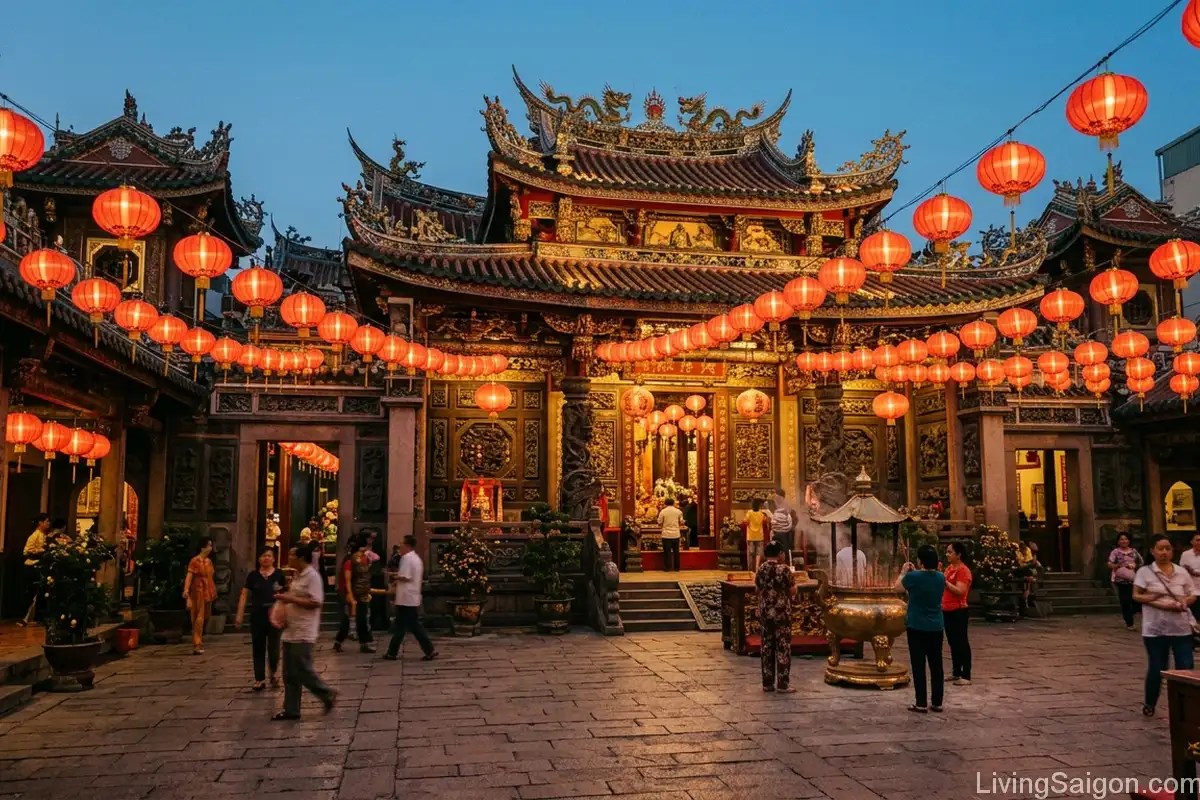
The most visited and most visually spectacular of Cholon’s many temples is Thien Hau (Ba Thien Hau Thanh Mau), dedicated to Mazu — the goddess of the sea and protector of sailors and fishermen, among the most important deities of the Teochew and Cantonese communities. Built in the early nineteenth century and maintained by the Cantonese congregation, the temple is a masterpiece of southern Chinese temple architecture: a layered complex of pavilions and courtyards, with an exterior roofline of elaborately painted ceramic figures depicting scenes from Chinese mythology and history.
The interior of Thien Hau is always active — incense coils hang from the ceiling in spirals, worshippers make offerings at the various altars, and the gilt statues of Mazu and her attendant deities preside over the main hall with the accumulated gravity of two centuries of continuous veneration. The temple is busiest during major festival dates (especially the 23rd day of the third lunar month, Mazu’s birthday), when the streets outside fill with processions and ceremonies. Our guide to Cholon and Chinatown in Saigon covers the full cultural quarter in depth.
Binh Tay Market — The Commercial Heart of Cholon
The Binh Tay Market anchors the commercial life of Cholon and operates at a scale that is genuinely staggering if you haven’t seen it before. Built in the 1920s on land donated by a prominent Teochew merchant, the market covers an enormous area and serves as the primary wholesale hub for goods distributed throughout southern Vietnam. Electronics, fabrics, spices, dried goods, Chinese herbal medicines, household goods, and industrial quantities of every imaginable product flow through Binh Tay on a daily basis.
The market is a working commercial operation, not a tourist site, and approaching it as such produces a significantly more interesting experience. The activity in the early morning hours — when the wholesale buyers arrive, when the porters move goods through the market lanes at speed, when the vendors prepare their stalls — is extraordinary in its density and organization. The central courtyard with its tiled roof, the clock tower, and the character of the building itself are architectural pleasures independent of the commercial activity taking place beneath them.
Ben Thanh Market and the Cultural Commerce of District 1
Ben Thanh Market occupies a specific position in Saigon’s cultural landscape: it is simultaneously an overpriced tourist destination, an active local market with genuine neighborhood functions, and one of the most architecturally distinctive buildings in the city. Understanding all three dimensions simultaneously produces a more nuanced and more interesting visit than approaching it with only one in mind.
The Art Deco-influenced facade and clock tower were completed in 1914, replacing an earlier wooden market that had occupied the same site since the French established it in the 1860s. The building has served continuously as a market for over a century, making it one of the few cultural sites in Saigon that has functioned in exactly the same capacity across the French colonial period, the Republic of Vietnam, and the Socialist Republic. The physical continuity of that commercial function is itself historically meaningful.
For practical shopping, the prices inside are significantly above local market rates — a deliberate calibration toward the tourist trade that has been underway for decades. For the cultural experience and the atmosphere, the market remains genuinely engaging: the density of goods, the calls of vendors, the Vietnamese and foreign customers negotiating in multiple languages, and the sensory overload of a covered market that operates at full intensity from opening until closing. Our guide to the Ben Thanh Market in Saigon covers the market’s history and practical visiting information in detail.

Historical Cultural Sites in Saigon: The Colonial and War Layers
The cultural sites in Saigon include not only religious and commercial spaces but a layer of political and military history that is unavoidable in a city that was the capital of South Vietnam during one of the most significant conflicts of the twentieth century.
The War Remnants Museum — A Confronting Cultural Encounter
The War Remnants Museum (Bao Tang Chung Tich Chien Tranh) is the most visited museum in Vietnam and one of the most viscerally affecting cultural sites in the country. Its focus is the Vietnam War — specifically the American military involvement and its human consequences — presented from the Vietnamese perspective with a directness and an absence of diplomatic softening that can be genuinely confronting for Western visitors, particularly Americans.
The museum’s outdoor courtyard contains American military hardware — tanks, artillery pieces, helicopters, aircraft — captured during the war. The interior galleries document the conflict through photographs, equipment, and testimony, with significant sections dedicated to the effects of Agent Orange and other defoliants on the Vietnamese population, the treatment of prisoners, and the international anti-war movement.
The museum is important not because it provides a balanced account — it doesn’t, and doesn’t pretend to — but because it provides a Vietnamese account of events that are typically narrated in Western media from the American perspective. Understanding that this perspective exists, and why it exists in the form it does, is an essential part of understanding contemporary Vietnam and its relationship with the United States. Entry is approximately 40,000 VND for foreigners; plan two to three hours for a serious visit.
The Cao Dai Great Temple — Saigon’s Syncretic Religion
Cao Daism is one of the most distinctive religious phenomena in the world — a syncretic Vietnamese religion founded in the 1920s that incorporates elements of Buddhism, Taoism, Confucianism, Christianity, and Islam, venerating figures as diverse as Victor Hugo, Sun Yat-sen, and Joan of Arc as saints alongside traditional Asian religious figures. The faith’s headquarters is in Tay Ninh province, about ninety minutes from Saigon, but several Cao Dai temples exist within the city itself.
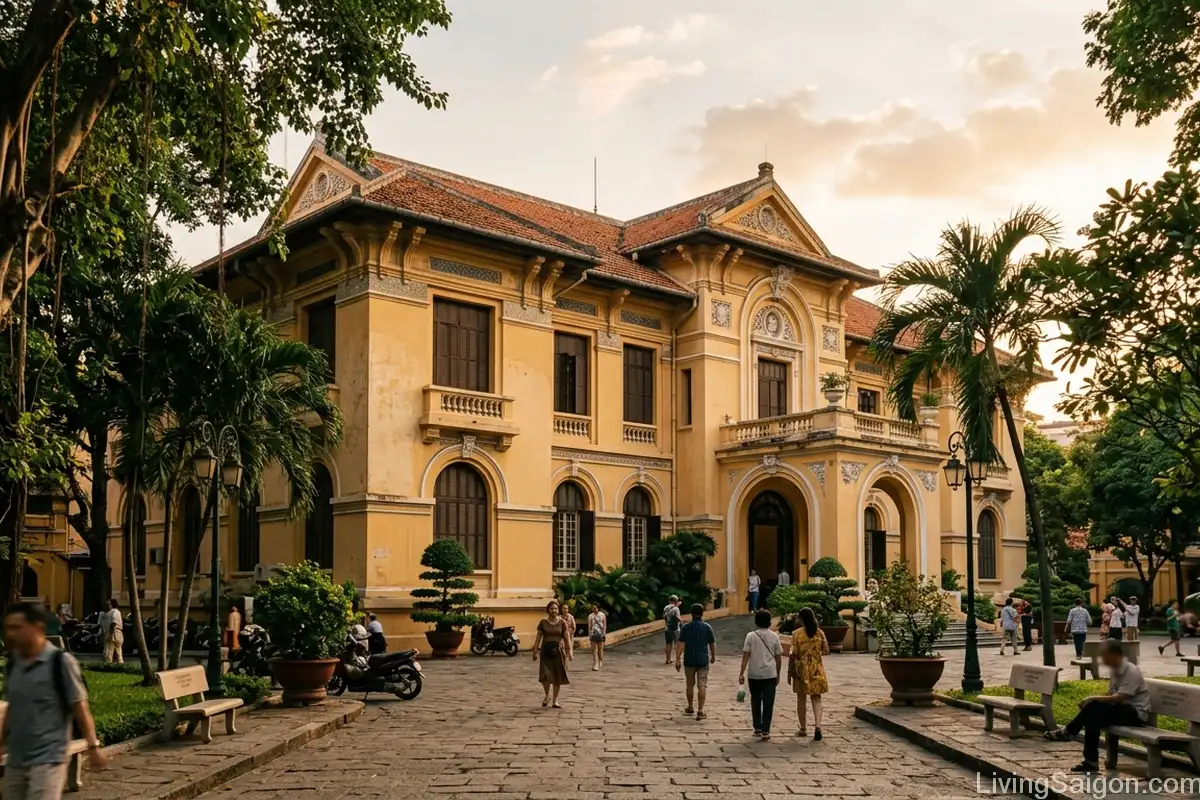
The elaborately decorated Cao Dai temples, with their distinctive architecture combining Vietnamese, Chinese, and European influences, are among the most visually extraordinary cultural sites in Saigon and the surrounding region. The twice-daily ceremonial prayers, with priests in white robes and laypeople in colored clothing representing the three branches of the religion, provide one of the most visually remarkable religious spectacles in Southeast Asia.
Cultural Sites in Saigon: The Living Streets
Beyond the individual sites and buildings, some of the most genuinely cultural spaces in Ho Chi Minh City are simply the streets themselves — the lanes and alleys where the city’s diverse communities have lived continuously for generations and where daily life constitutes an ongoing cultural practice.
Ton That Dam and the Old Chinese Commercial Streets
The streets of Cholon’s commercial core — Ton That Dam, Trieu Quang Phuc, and the surrounding lanes — retain a commercial character and a physical fabric that has changed relatively little in decades. The warehouse buildings, the traditional shop-houses with their ground-floor commercial spaces and upper-floor residential accommodation, the clan association halls that serve both as social institutions and as temples, and the persistent presence of Chinese-language signage alongside Vietnamese give these streets a specific cultural texture that is disappearing from most of Asia’s commercial districts under development pressure.

The Catholic Quarter of Districts 1 and 3
The Vietnamese Catholic community — one of the largest in Asia, with a history dating to seventeenth-century Portuguese missionary activity and dramatically shaped by the colonial French period and the post-1975 diaspora — has left a distinctive physical mark on the city’s inner districts. The concentration of Catholic churches, schools, and community institutions in Districts 1 and 3 creates a cultural landscape that is simultaneously Vietnamese and European in character, reflecting the particular history of Vietnamese Catholicism’s development across four centuries.
The area around the Notre Dame Cathedral, the various parish churches that serve the neighborhoods of District 3, and the Catholic cemeteries and schools that occupy significant blocks of inner-city land are cultural sites in the most literal sense — places where a living religious community continues to practice a faith that was imported by colonialism and subsequently made entirely Vietnamese. For a deeper exploration of these religious sites alongside the full range of Saigon’s spiritual landscape, our guide to religious places in Saigon covers the city’s faith communities comprehensively.
Visiting the Cultural Sites in Saigon: Practical Approach
The cultural sites in Saigon reward a specific approach that differs from typical tourist sightseeing. The following principles consistently produce more rewarding visits.
Visit religious sites in the morning when they are most active, rather than in the afternoon when they are quieter. The activity — the prayers, the incense offerings, the fortune-telling rituals — is what gives these places their cultural meaning, and that activity peaks in the early morning hours before the heat builds and the crowds arrive.
Dress and behave respectfully at places of active worship. Shoulders and knees covered, shoes removed when entering temple halls, voices kept low, and camera use that doesn’t intrude on worshippers’ privacy — these courtesies are not merely polite but are necessary for the sites to continue being genuinely available to visitors rather than closed to outside access.
Spend more time at fewer sites rather than trying to cover as many as possible in a day. The cultural depth of the Jade Emperor Pagoda, for instance, is not apparent in a fifteen-minute visit but becomes genuinely engaging over an hour, during which you can observe the different forms of prayer and offering, examine the iconography of the individual shrines, and begin to understand the complexity of the religious tradition being practiced.
For guided access to the cultural sites that goes beyond what self-directed visiting provides — the explanations of iconography, the introductions to temple guardians, the navigation of the Cholon market quarter — our Saigon city tour options include cultural itineraries specifically designed around the heritage sites covered in this guide. And for the full picture of the historical layer alongside the cultural one, the museums in Saigon guide and the day trips from Saigon guide extend the cultural exploration beyond the city’s administrative boundaries to the sites — Tay Ninh, Cu Chi, the Mekong Delta — that give the city’s urban culture its regional context. The Instagram spots in Saigon guide covers the most photogenic angles and settings at many of the cultural sites described here, for those who want to combine cultural engagement with photography.