

Saigon holds its history unusually close. In most rapidly developing Asian cities, the past is eventually demolished, overbuilt, or relegated to a museum — here, the French colonial buildings stand alongside glass towers, the century-old market operates in the shadow of a modern shopping center, and the palaces of successive governments remain open and inhabited by their own quiet significance. The landmarks Saigon are not just photo opportunities; they are a compressed lesson in one of the most layered and dramatic urban histories in Southeast Asia.
This guide covers the essential landmarks in Saigon — the sites that belong on any serious visitor’s itinerary — with the detail that makes the difference between walking past something beautiful and actually understanding what you’re looking at. Each landmark is covered with its history, what to expect from a visit, the best time to go, and what makes it genuinely worth your time. The broader cultural and historical dimension is explored further in the cultural sites in Saigon guide and the museums in Saigon guide. For those who want to experience the landmarks with a guide who can bring them to life, the Saigon city tour options cover several itinerary formats that include the major sites.

The Essential Landmarks in Saigon: The Colonial French Quarter
The most concentrated collection of Saigon’s landmarks occupies a relatively compact area in District 1’s Ben Nghe ward — the former heart of the French colonial city, now a remarkable urban palimpsest where nineteenth-century civic architecture stands cheek-by-jowl with Vietnamese commercial activity and contemporary development. A morning walking the streets of this area — early enough to beat the midday heat and the crowds — is one of the most rewarding experiences in the city.
Notre Dame Cathedral — The French Colonial Icon
The Basilica of Our Lady of the Immaculate Conception — universally known as the Notre Dame Cathedral of Saigon — was built between 1863 and 1880 using materials imported entirely from France. The red brick facing came from Marseille; the stained glass windows were fabricated in Chartres; even the ornamental ironwork was shipped from France and assembled in Vietnam. The result is a piece of French ecclesiastical architecture that landed in the tropics and somehow flourished there — the twin bell towers and neo-Romanesque facade having become the defining visual icon of the city’s colonial-era skyline.
The cathedral is an active place of Catholic worship, and the religious dimension of a visit matters to understanding it properly. Sunday masses draw large congregations of Vietnamese Catholics, and the cathedral square fills with families and worshippers in a way that gives the building a living presence that purely museum-status landmarks lack. The interior is ornate and well-preserved; the stained glass in particular merits close attention.
Visiting hours for tourists are outside of service times, typically in the morning before 10am and in the afternoon after 3pm on weekdays. Our dedicated guide to Notre Dame Cathedral in Saigon covers visiting hours, mass schedule, and what to look for inside in detail.

Central Post Office — Eiffel’s Gift to Saigon
Directly adjacent to the cathedral and connected to it by the Paris Square garden between them, the Central Post Office is one of the most architecturally impressive buildings in Vietnam — and one of the few working post offices in the world that constitutes a genuine tourist attraction in its own right. Designed by Gustave Eiffel (of Eiffel Tower fame) in the early 1880s and completed in 1891, the building features a spectacular vaulted iron ceiling, a mosaic tile floor in warm ochre and terracotta, and two enormous historical maps of Saigon and its environs that line the interior walls.
The post office continues to function as an actual post office — you can send letters and postcards from inside, which provides a particular satisfaction that few other tourist activities offer. The building’s interior is beautiful at any time of day, but the quality of natural light through the upper windows in the morning hours makes it especially worth visiting early. Entry is free, and the building is typically open from 7am to 7pm on weekdays. Our article on the Central Post Office Saigon covers the architectural history and what to look for when you visit.

City Hall — The Ornamental Heart of District 1
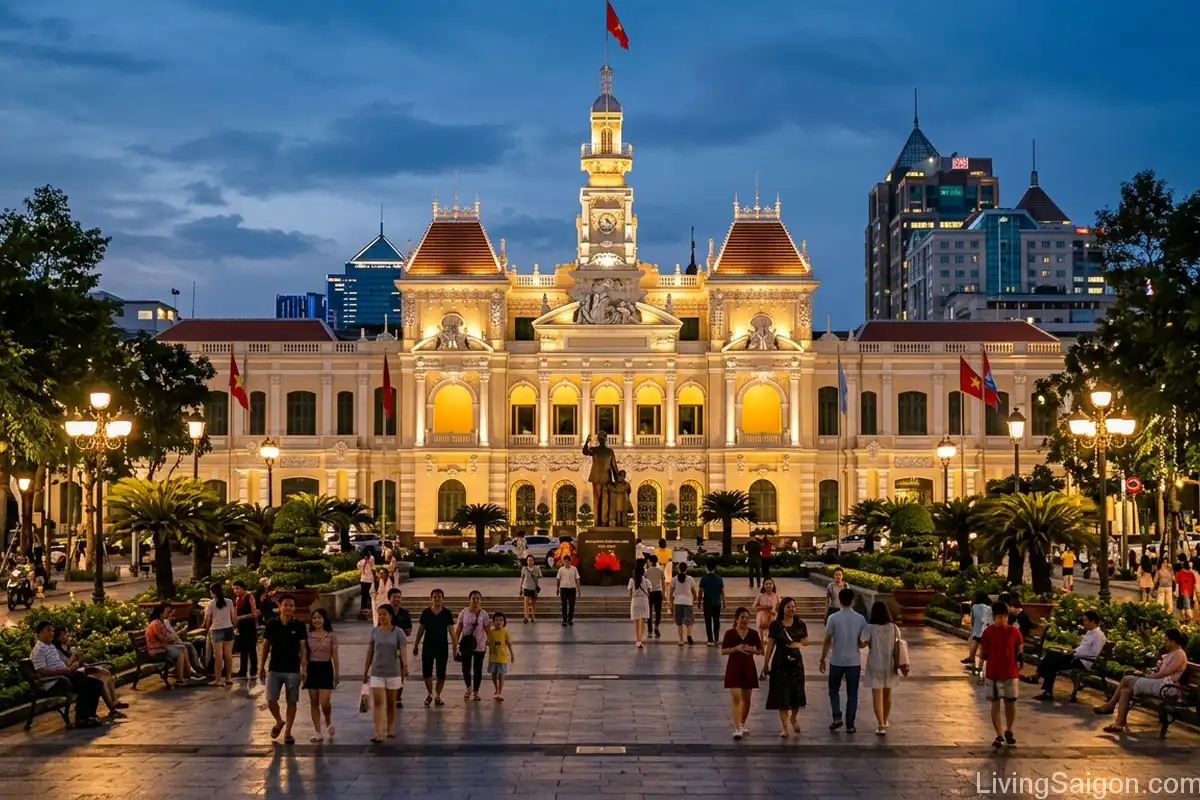
The Ho Chi Minh City People’s Committee Building — known universally as City Hall — anchors the northern end of the Nguyen Hue pedestrian boulevard and is arguably the single most photographed building in the city. Completed in 1908 in a florid French colonial baroque style, the building served as the administrative center of French Indochina at various points in its history and continues as the seat of city government. It is not open to the public, but its value as a landmark is entirely visual — the yellow-and-white facade, illuminated dramatically at night, provides one of the most iconic backdrops in Ho Chi Minh City.
The statue of Ho Chi Minh in front of City Hall — Ho Chi Minh holding a child, with the building’s ornate facade behind — is the photograph that appears on every postcard and tourism material for the city. It is best seen in the early morning light before the crowds build, and is particularly beautiful at the golden hour before sunset. For a dedicated guide to the building’s history and the significance of the surrounding area, our article on City Hall in Saigon covers the full story.
The Landmarks Saigon Walking Street: Nguyen Hue Boulevard
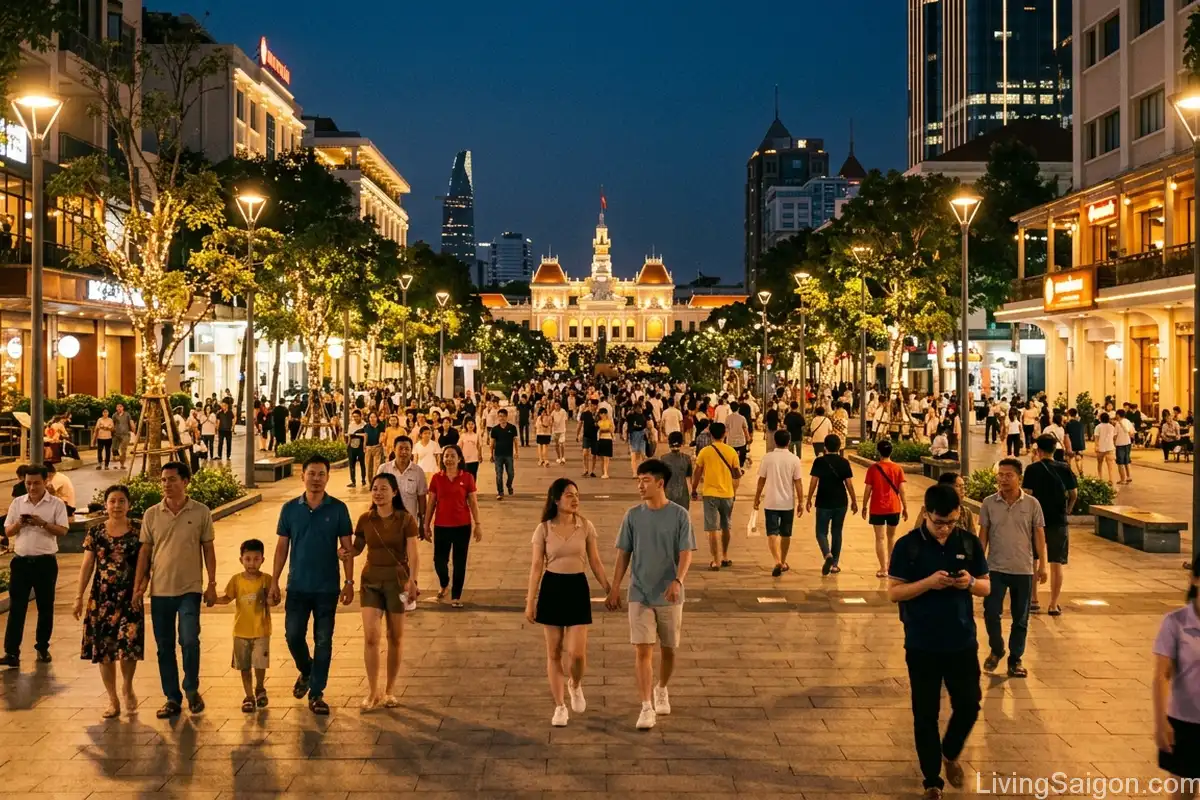
The Nguyen Hue pedestrian boulevard — stretching approximately 670 meters from City Hall to the Saigon River — is the city’s primary public gathering space and one of the most vibrant urban environments in Southeast Asia. The boulevard was pedestrianized and renovated in 2015 and has since become the social center of District 1: a wide, tree-lined space where families gather in the evenings, where festivals and public events are staged throughout the year, where the city’s population appears in its full diversity simply to walk, sit, and be present in an open space that the density of Saigon’s neighborhoods rarely provides.
The boulevard is most compelling at either end of the day — early morning for the light and the space before the crowds build, and the evening from around 5:30pm when the temperature drops and the entire length fills with activity. The fountain at the center of the boulevard changes color with different light programs in the evening hours. Street performers, families on electric scooters, young couples having photos taken in traditional áo dài, and older Vietnamese doing their evening walk — the Nguyen Hue boulevard at dusk is one of those city experiences that justifies travel in itself. Our dedicated guide to the walking street in Saigon covers all the best times and what to explore in the surrounding area.
Modern Landmarks in Saigon: The New Skyline
The landmarks of Saigon are not only colonial-era architecture. The city’s rapid economic development over the past three decades has produced a new layer of landmark buildings that represent Vietnam’s contemporary ambitions as clearly as the French colonial structures represent its colonial past.
Bitexco Financial Tower — The Defining Skyline Element
The Bitexco Financial Tower, designed by American architect Carlos Zapata and completed in 2010, was Vietnam’s tallest building until Landmark 81 surpassed it in 2018. At 262 meters with its distinctive helipad jutting from the 52nd floor like a cantilevered disc, the Bitexco Tower remains the most visually distinctive element of the District 1 skyline — visible from every elevated position in the city and recognizable in profile from any angle.
The Saigon Skydeck observation deck on the 49th floor is the most dramatic public vantage point over the city center. From this height, the organizational logic of Ho Chi Minh City becomes visible in ways that ground-level experience doesn’t provide: the river curving through the urban fabric, the density of the French Quarter’s tile rooftops contrasting with the glass towers, the green patches of parks, and the sprawl of development extending in every direction. The views at sunset, when the low light hits the river and the western suburbs, are genuinely spectacular.
Entry to the Skydeck is approximately $12–15 USD. The experience is worthwhile once — particularly at sunset — and provides the geographic orientation that makes subsequent exploration of the city more meaningful. For the full guide to visiting with current opening times and pricing, our article on the Bitexco Tower Saigon covers everything you need to know.

Landmark 81 — Vietnam’s Tallest Building
Since 2018, Vietnam’s tallest building has been Landmark 81 in Binh Thanh, visible from much of the city as a distinctive silvery column rising 461 meters on the east bank of the Saigon River. The Vingroup development includes a hotel, residential towers, and an integrated shopping mall (Vincom Mega Mall), but the building’s identity is primarily defined by its sheer height and its observation deck — the Landmark 81 Skydeck on the 79th–81st floors, offering the most elevated views available to the public in Vietnam.
The views from Landmark 81 are wider and more panoramic than from the Bitexco Tower, but the distance from the city center means they include more suburban sprawl and less of the historically interesting urban core. For photography and sheer scale, it’s remarkable. For understanding the city’s geography and history, the Bitexco Skydeck is arguably more informative despite being lower. Both are worth experiencing if time permits — they give complementary perspectives on the city.
Cultural and Historical Landmarks in Saigon
Beyond the colonial and contemporary architectural landmarks in Saigon, the city contains several sites of profound historical and cultural significance that merit serious attention from anyone who wants to understand what Ho Chi Minh City is and why it has its particular gravity.
Reunification Palace — The Building That Ended a War
The Reunification Palace (also known as Independence Palace) is one of the most historically charged buildings in Southeast Asia. On April 30, 1975 — the day that ended the Vietnam War — a North Vietnamese tank famously crashed through the palace gates, an image that became the definitive visual symbol of the war’s conclusion. The palace had served as the official residence and workplace of the South Vietnamese president; the tank’s entry ended that chapter of history.
The building is now preserved exactly as it was on that day — a time capsule of mid-century modernist design, government aesthetics, and the particular atmosphere of an era of high geopolitical stakes. Touring the reception rooms, the war operations center in the basement, the rooftop helicopter pad, and the private apartments gives a tangible connection to events that feel distant in history but are embodied physically here in a way that reading about them cannot replicate. Hours and admission fees apply — entry is approximately 40,000 VND for foreigners and the site is open most mornings and afternoons. For a full visit guide, our article on the Independence Palace in Saigon covers the history and what to see inside.
Ben Thanh Market — The Living Symbol
Ben Thanh Market is the most famous building in Saigon that isn’t primarily a building — it’s a market, a symbol, and a social institution that has been at the center of Saigon’s commercial life since 1914. The distinctive clock tower entrance and the Art Deco-influenced facade have appeared on more postcards and tourism materials than any other Saigon image, and the market itself continues to operate as a working market serving both tourists and local shoppers.
The honest assessment for visitors: Ben Thanh is worth seeing for the building and the atmosphere, but the prices inside are tourist-facing and significantly higher than in neighborhood markets for equivalent goods. Come for the experience rather than for shopping — and explore the night market stalls that surround the exterior from around 6pm, where the food options are better value and the atmosphere more authentically mixed. The broader guide to Saigon’s cultural sites in Saigon covers Ben Thanh alongside the city’s other significant cultural landmarks.
Visiting the Landmarks in Saigon: Practical Guide
A few practical considerations that make visiting Saigon’s landmarks significantly more rewarding.
The Best Route: The French Quarter Walk
The colonial-era landmarks in District 1 are close enough together to be covered in a single morning walk. Starting from the Notre Dame Cathedral (arrive by 8am for the best light and smallest crowds), crossing to the Central Post Office, walking down to City Hall via Dong Khoi, then continuing along Nguyen Hue to the river — this route covers the most historically significant landmarks in about two to three hours at a comfortable pace, with enough time for photographs and interior visits at each stop. The walk is best done Tuesday to Sunday when all sites are open, and specifically in the morning before the heat builds and the tour groups arrive in numbers.
Getting to the Landmarks
All the District 1 landmarks are accessible on foot from each other — the French Quarter is compact enough that the distances between sites are five to fifteen minutes’ walking. From accommodation in Thao Dien or other neighborhoods, Grab to District 1 is the most reliable arrival method. The Metro Line 1 terminus at Ben Thanh is adjacent to the market and a short walk from most of the French Quarter landmarks, making it a viable option for those staying near a metro station on the east bank.
Photography and the Best Light
The landmarks of Saigon photograph best in specific conditions. The Notre Dame Cathedral and City Hall are best in the morning (the facade faces east and catches the golden morning light directly). The Bitexco Tower and the views from elevated positions are best at sunset. The Nguyen Hue walking street is best at the golden hour before dark and in the early evening when it fills with people and the fountain is lit. Planning visits around light conditions rather than convenience produces dramatically better photographs and a more memorable experience.
For the city’s most photogenic locations beyond the primary landmarks — the hidden courtyards, the colorful street art, the cafe rooftops and riverside walkways that have become essential on the city’s visual itinerary — the Instagram spots in Saigon guide covers locations that reward the camera across the full range of the city’s neighborhoods and hours. And for extending your experience of the city’s history and culture beyond the landmarks themselves into the museums and deeper historical sites, the museums in Saigon and day trips from Saigon guides cover the next layer of what the city and its surroundings have to offer.
The landmarks in Saigon are not just for tourists — they are the physical address of the city’s history, and spending time with them carefully, rather than collecting them as checkbox visits, is one of the genuinely enriching things a stay in Ho Chi Minh City makes possible.