

Saigon is a photographer’s city in the most genuine sense — not because it has been curated for the camera, but because the collision of history, culture, and rapid transformation happening on its streets produces visual material that is inherently compelling at every turn. The Instagram spots Saigon range from the famous and immediately recognizable (the yellow facade of the Central Post Office, the twin towers of Notre Dame Cathedral, the Nguyen Hue walking street at golden hour) to the deeply hidden and discovered only through hours of laneway wandering — the painted courtyard behind an unmarked gate, the rooftop terrace accessible through a building whose street-level facade gives no indication of what’s above, the century-old temple courtyard where afternoon light falls at a specific angle for approximately forty-five minutes each day.
This guide covers the full spectrum of the city’s photographic possibilities — organized by type of location rather than by list, because understanding the categories of Instagram spots in Saigon is more useful than any specific list of venues that changes as cafes open and close and new locations emerge. For the historical landmarks that provide the city’s most recognizable backdrops, the landmarks in Saigon guide covers the context and visiting logistics. For the rooftop bars that offer the city’s most dramatic elevated perspectives with the added advantage of a drink in hand, the rooftop bars in Saigon guide is the natural companion. And for the cafes specifically built around visual culture and photogenic interiors, the best cafes in Saigon guide covers the current scene comprehensively.
Why Saigon Photographs So Well
Before getting to specifics, it’s worth understanding what makes Saigon such a particularly rewarding city for photography — because understanding this helps you find the best Instagram spots in Saigon independently, rather than being dependent on a static list.
The city’s visual appeal comes from three overlapping qualities. The first is the density and diversity of its architectural layers — French colonial buildings, Chinese shophouses, Vietnamese tube houses, Soviet-influenced brutalist concrete blocks, and contemporary glass towers all occupying the same streets, creating a visual complexity that no planned city can replicate. The second is the quality of the light. Saigon sits at a latitude (10.8° N) that produces a golden hour of extraordinary warmth and duration — in the dry season, the late afternoon light between about 4:30pm and 6pm turns the city’s yellowed colonial facades and terracotta tile roofs into something almost luminous. The third is the sheer quantity of street-level activity at all hours — the food cart vendors, the motorbike traffic, the market scenes, the cafes spilling onto pavements — which means that virtually any street in any neighborhood contains human activity worth photographing at any time of day.
Rooftop and Elevated Instagram Spots in Saigon
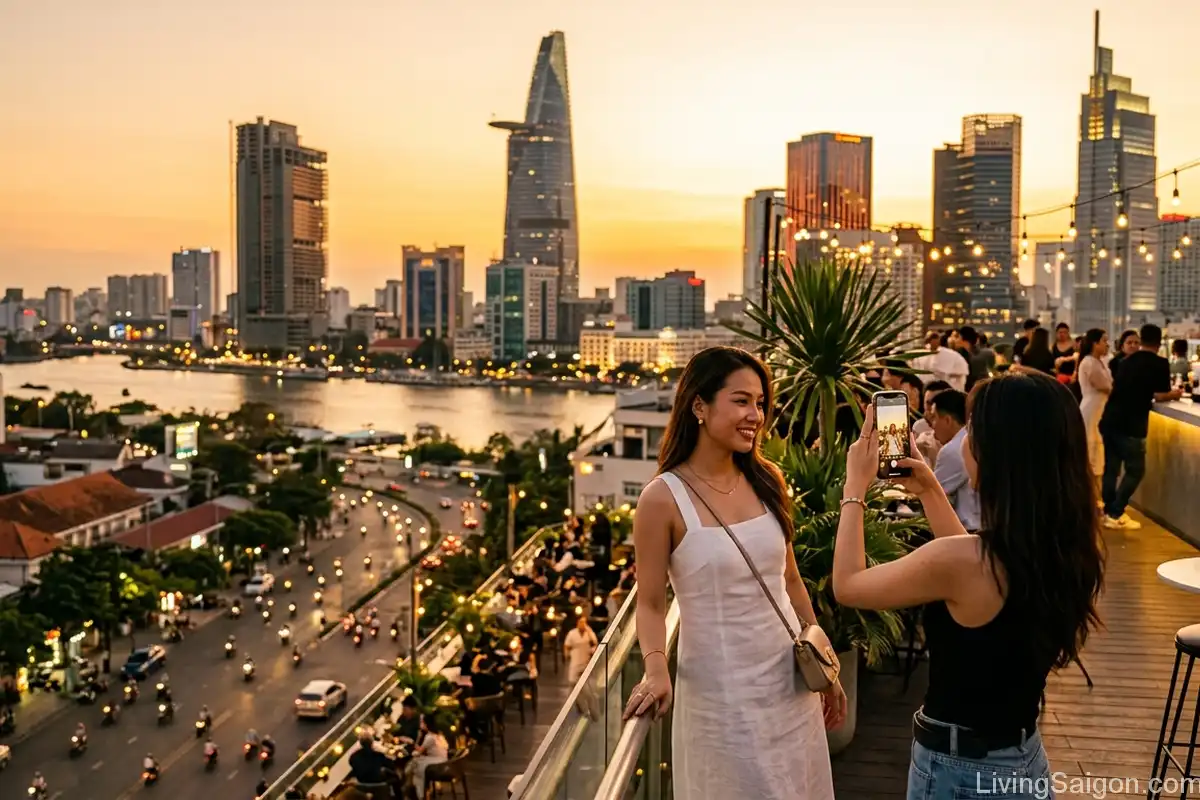
The elevated perspective is one of the defining photographic opportunities of Saigon — the city’s skyline, particularly when viewed from positions that capture both the colonial-era rooftscape of Districts 1 and 3 and the glass towers of the modern CBD, is visually extraordinary in ways that ground-level photography cannot convey.
The Bitexco Skydeck
The observation deck on the 49th floor of the Bitexco Financial Tower offers the most complete panoramic view of central Saigon available to the public at a fixed address. The distinctive helipad disc visible from below is the most recognizable element of the building — from the Skydeck, that disc is at eye level and the view extends across the full sweep of the city center, the river bends, and on clear days the suburban sprawl that extends in every direction. The best photography time is approximately one hour before sunset, when the light is warm and directional without the full flatness of afternoon overhead light. The Skydeck charges approximately $12–15 USD for entry — a reasonable cost for access to one of the best fixed Instagram spots in Saigon.
Hotel and Bar Rooftops
Beyond the formal observation decks, Saigon has a rich landscape of hotel and bar rooftops that offer elevated views with the added atmosphere of being social spaces rather than tourist platforms. The rooftop bars of District 1 — several operating at heights between eight and twenty-five stories — provide the city skyline as backdrop for the kind of photography that combines landscape and lifestyle: drinks on a rooftop against a sunset, the city spread below, the specific social energy of Saigon’s elevated bar scene. The full guide to the best rooftop venues with current opening hours and pricing is in the rooftop bars in Saigon guide.

Hidden Rooftop Terraces
The category of hidden rooftop terrace — a building whose unremarkable street facade conceals a rooftop or upper-floor terrace with surprising views — is one of the most productive categories for discovery photography in Saigon. Several of the city’s most photographed rooftop locations are cafes or small bars on the upper floors of buildings in Districts 1, 3, and Binh Thanh that have no visible street-level indication of what’s above. These places circulate through the local photography and expat community by word of mouth, and finding them requires either local knowledge or the patience to explore through discovery rather than planning. Our dedicated guide to photo spots in District 1 covers the hidden rooftop options alongside the more accessible elevated locations in detail.
Aesthetic Cafes: The Core of Saigon’s Instagram Scene
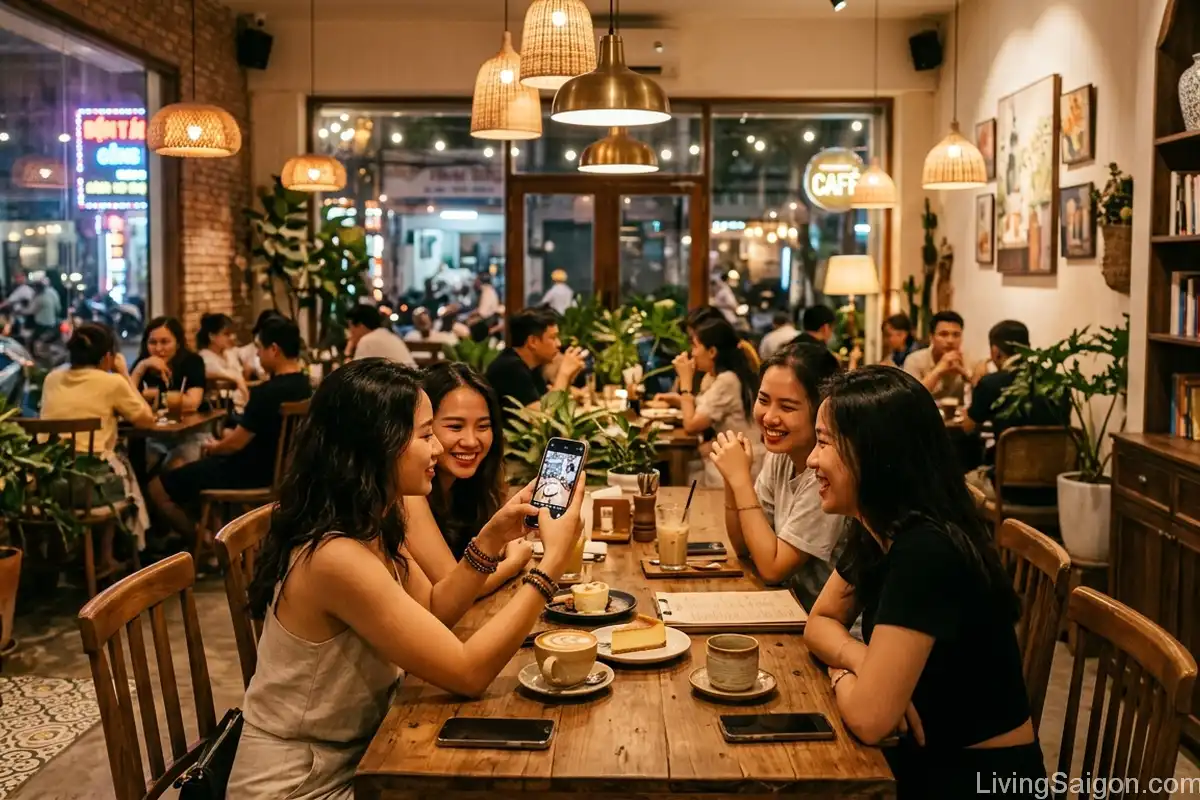
The cafe is the defining unit of visual culture in Saigon. More than any other single category of location, the city’s Instagram spots are concentrated in its cafes — and not by accident. The deliberate visual investment that Saigon’s cafe owners make in their spaces, the quality of natural light that the city’s climate and building typology make available, and the culture of slow, extended cafe sitting that creates a market for visually ambitious cafe design have combined to produce an extraordinarily rich landscape of photogenic interiors.
What Makes a Great Instagram Cafe in Saigon
The best photography cafes in Saigon share several qualities. They have a relationship with natural light — a window orientation that catches the morning or afternoon sun at angles that create soft shadows and warm tones rather than harsh overexposure. They have a design coherence — not just decoration piled on decoration, but a considered aesthetic where the materials, colors, and furnishings work together to create a specific visual character. And they have enough spatial depth to allow compositional variety: a corner with direct light, a mid-room position with ambient light, a specific wall or object that functions as a focal point for portrait photography.
The city’s aesthetic cafe landscape is not concentrated in a single neighborhood. District 3 has some of the strongest cafes for photography — the specialty coffee venues in colonial-era shophouses along Vo Van Tan and surrounding streets frequently combine excellent natural light with architectural character that no purpose-built venue can replicate. Thao Dien has the highest density of expat-facing Instagram cafes. Binh Thanh has the most independently oriented and least tourist-curated cafe photography options. District 1 has the most easily accessible options for visitors staying centrally, though the quality-to-tourist-density ratio is worse than in the secondary neighborhoods. Our specific guide to cafes for Instagram in Saigon covers the current best options by neighborhood.
The Colonial Architecture Zone: Built-In Instagram Spots in Saigon
The French Quarter of District 1 — the compact area around Dong Khoi, Ly Tu Trong, and the streets connecting them to the Notre Dame Cathedral and Central Post Office — is the most consistently photogenic neighborhood in Saigon, and requires no specific venue discovery: the buildings themselves are the subject.
The Classic Facades
The yellow ochre facades of the colonial-era buildings that line Dong Khoi and its side streets are among the most photographed architectural elements in Vietnam. The color — a particular warm yellow that the French colonial administration used consistently across their Indochina buildings — catches the morning and late afternoon light with a luminosity that is almost impossible to capture poorly. The best photography of these streets happens in the early morning (before the street-level traffic builds and the light is clean and directional) and in the forty-five minutes before sunset (when the low western light hits the eastern-facing facades with exceptional warmth).
The Notre Dame Cathedral square, the Central Post Office facade (with its distinctive yellow and white banding), and the Reunification Palace’s long green lawn and modernist front elevation are all accessible without admission fees for exterior photography — and all three are genuinely beautiful at the right time of day. The landmarks in Saigon guide covers the visiting logistics and the best photography positions for each of these sites.
The Walking Street as Photography Location
The Nguyen Hue pedestrian boulevard functions differently at different times of day for photography. In the morning, the wide empty boulevard with the City Hall at the far end and the fountain in the middle creates a graphic, symmetrical composition that works particularly well for architectural photography. In the late afternoon, the boulevard fills with Vietnamese families, couples in áo dài, children on electric scooters, and the general social energy of the city at leisure — which is a different and arguably more interesting photographic subject. At sunset and into the evening, the fountain’s colored light displays and the illuminated City Hall facade create the classic Saigon night photography composition that appears on most tourism materials. Our article on sunset spots in Saigon covers the timing and positioning for golden-hour photography across the city’s best locations.

Hidden Saigon: The Best Undiscovered Instagram Spots Saigon
Beyond the obvious landmarks and the known cafes lies what many serious photographers consider the most rewarding photographic territory in the city — the hidden spots that require actual exploration to find. Saigon’s urban fabric is extraordinarily dense and complex, and the practice of wandering through secondary streets, ducking into laneways (hẻm), and following visual curiosity produces encounters with spaces and scenes that no guide can reliably catalog because they change as the city evolves.
The Hẻm Culture
The hẻm — the narrow residential laneways that penetrate behind the main street frontages of Vietnamese urban neighborhoods — are the most photogenic category of urban space in Saigon and the least photographed by visitors who confine themselves to main streets. Inside the hẻm of Districts 1, 3, 4, and Binh Thanh, the street life of Vietnamese residential neighborhoods unfolds at close range: children playing, elderly residents in plastic chairs, motorbike repair shops, food stalls that serve only the immediate neighborhood, doorways opening into domestic interiors, cats and dogs inhabiting the shared space, plants growing from every available container. The hẻm photography tradition in Saigon is substantial — serious documentary and street photographers have spent careers exploring these spaces — and any visitor who spends an afternoon walking into laneways rather than staying on main roads will encounter photographic material that feels genuinely discovered.
Cholon’s Visual Universe
The Chinese district of Cholon in Districts 5 and 6 is perhaps the single richest district for photography in the city — the density of visual material (the temple facades, the red lanterns, the Chinese-character signage, the market activity, the clan association halls, the street food that looks unlike anything in the main Vietnamese food scene) creates a photographic environment that feels entirely different from the rest of the city. The Thien Hau Temple interior, the Binh Tay Market building, and the streets around Phan Van Khoe are all worth extended photographic exploration. Our guide to hidden photo locations in Saigon covers Cholon alongside other undervisited photography destinations across the city’s districts.
Instagram Spots in Saigon by Time of Day
Understanding when to photograph each category of location transforms the experience from frustrating (fighting harsh midday light, crowds at the main landmarks) to consistently productive.
Early Morning (6–8:30am)
The best time for street photography in the market districts and hẻm networks — the city’s residential streets are most active in this window, before the heat builds and the outdoor activity retreats indoors. The wet markets surrounding Tan Dinh, Ben Thanh, and the Cholon markets operate at peak intensity between 6am and 8am. The colonial facades in the French Quarter catch clean, directional morning light. The Jade Emperor Pagoda in District 3 is most atmospheric in the first hours of the day when worshippers arrive for morning prayer.
Golden Hour (4:30–6pm)
The period of greatest photography productivity in Saigon. The Bitexco Skydeck at this time produces the best combination of city color and sky quality. The Nguyen Hue boulevard fills with Vietnamese families. The colonial facades on the east side of major streets catch the low western light. Rooftop bars begin filling with a social atmosphere that makes elevated photography more interesting. The street cafes along Pham Viet Chanh in Binh Thanh produce their best ambient light for interior photography. For the nightlife dimension that extends from golden hour into the evening — the transition from warm natural light to the neon and LED atmosphere of Saigon at night — the nightlife in Saigon guide covers the evening and late-night scene across the city’s different entertainment zones.

Street Style and Portrait Photography in Saigon
Beyond the location-based photography, Saigon offers extraordinary portrait and street style opportunities — the city’s population is visually diverse, beautifully dressed on formal occasions, and generally receptive to camera interaction once basic courtesy norms are observed.
The áo dài — Vietnam’s traditional long tunic dress, worn by women on significant occasions and increasingly by young Vietnamese as a fashion statement rather than solely for formal events — is one of the most photographically compelling garments in Asia. The concentration of áo dài photography in the French Quarter on weekends (where Vietnamese families and young women specifically choose the colonial backdrop for photography sessions) creates a scene that is simultaneously tourist-facing and genuinely culturally authentic. The Nguyen Hue walking street on weekend afternoons is the most accessible venue for this photography.

For photographers who want structured access to the city’s most photogenic locations — including insider knowledge of hidden spots, guidance on the best photography times for each location, and access to locations that require local navigation — the Saigon city tour programs include photography-focused options that specifically cover the Instagram spots in Saigon described in this guide. The photo-tour format allows you to focus on the camera rather than on navigation logistics, and a skilled local guide can anticipate the light and activity patterns that produce the strongest images at each location. For the Instagram-specific research on the city’s most-shared and most-photographed locations, our article on the top Instagram spots in Saigon goes even deeper into specific venues, exact positions, and timing guidance.