

Ask most newly arrived expats about Phu Nhuan and they’ll draw a blank. It doesn’t appear prominently in the expat relocation guides. No international school has made it their headquarters. No famous rooftop bar has put it on the map for tourists. And yet, among the long-term expat community — people who’ve lived in Saigon for three, five, ten years — Phu Nhuan turns up consistently in conversations about the city’s best-kept secrets. The people who’ve found it tend to stay. This Phu Nhuan district guide explains why.
Phu Nhuan is a small, centrally located district wedged between the airport corridor to the west and the more prominent Districts 3, 10, and Binh Thanh on its other sides. Its central position gives it some of the best location-to-price ratios in the entire city. Its predominantly Vietnamese residential character gives it an authenticity that the more expat-curated neighborhoods have largely traded away. And its food street — the Phan Xich Long strip, one of the city’s great neighborhood eating and drinking experiences — gives it a social anchor that rewards discovery more than almost any other single street in inner Saigon. For the broader context of how Phu Nhuan fits within Saigon’s neighborhood landscape, the districts in Saigon guide sets the stage.
Understanding the Phu Nhuan District: Geography and Character
Phu Nhuan is one of Saigon’s smaller inner districts by area — compact enough that most of it is accessible on foot or by short motorbike ride, but large enough to contain real variety in character and pricing. It sits on a roughly triangular piece of urban fabric between Binh Thanh to the east, Districts 3 and 10 to the south and southeast, and the airport approach corridor (Tan Binh district) to the west and northwest.
This triangular geography is significant for one practical reason: the airport. Phu Nhuan is among the most convenient districts for access to Tan Son Nhat International Airport — twenty minutes in light traffic, rarely more than thirty-five even when congestion builds. For expats who travel internationally with any frequency, or who receive regular visitors, this proximity is a genuine daily-life advantage that no other centrally located district provides at comparable rent levels.
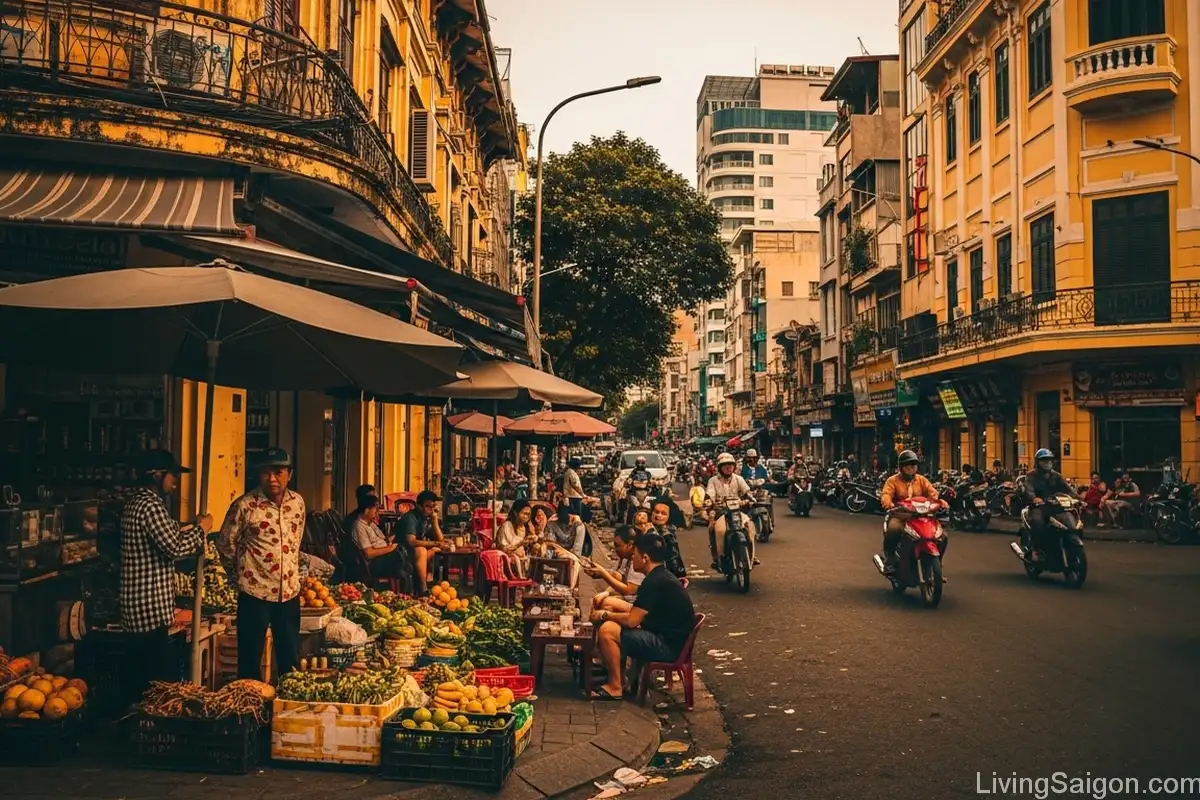
The district’s character is shaped primarily by its Vietnamese residential identity. Unlike Thao Dien, which has been substantially remade by its expat community over the past two decades, or Binh Thanh’s Pham Viet Chanh strip, which has been consciously developed with foreign residents in mind, Phu Nhuan’s streets are predominantly Vietnamese in orientation. The primary food culture is local. The markets serve local residents. The cafes cater primarily to Vietnamese customers. The neighborhood rhythm — early morning market activity, midday quiet, evening food stalls and street life — follows the patterns of Vietnamese urban life rather than the patterns of expat community schedules.
This is not a drawback for every expat. For people who want genuine immersion in Vietnamese city life — who are serious about learning the language, who want their daily environment to provide cultural education rather than cultural insulation — Phu Nhuan is one of the best-positioned inner districts to provide exactly this, without sacrificing central location or basic urban comfort.
Phu Nhuan District Guide: The Key Streets and Sub-Areas
Understanding which streets define the Phu Nhuan district’s character helps enormously when choosing where in the district to look for an apartment and how to orient your daily life.
Phan Xich Long: The Street That Defines Phu Nhuan
Phan Xich Long is the reason food writers and restaurant-guide authors who bother to explore beyond the obvious tourist trail consistently end up writing about Phu Nhuan. This street — and its network of immediately surrounding lanes — contains one of the most concentrated and genuinely excellent eating and drinking environments in inner Saigon, largely invisible to the tourist circuit because it caters primarily to Vietnamese residents and the small but growing community of expats who’ve found the district.
The range of what’s available along and around Phan Xich Long is impressive for a relatively short street. Vietnamese home-cooking restaurants serving dishes from multiple regions — proper bun bo Hue from a woman who learned the recipe in Hue, banh canh from a stall that’s been in the same spot for fifteen years, com nieu (claypot rice) at a small restaurant that fills with office workers every lunch hour. Cafes that serve excellent Vietnamese drip coffee alongside homemade Vietnamese desserts. Beer gardens that draw a mixed Vietnamese and expat crowd in the evenings. International restaurants — Japanese, Korean, a decent pizza place — that have established themselves as the local expat community has grown.
The character of the street is distinctly different from the more internationally curated food strips of Thao Dien or the tourist-facing options of District 1. It feels Vietnamese first, which is part of what makes it interesting. The prices reflect this: a full meal on Phan Xich Long rarely costs more than $5–8 USD at a local restaurant, and the quality at the best places is genuinely excellent. For a curated breakdown of what’s worth eating and where specifically along this strip, our guide to food in Phu Nhuan covers the scene street by street.

Hoang Van Thu: The Main Commercial Boulevard
Hoang Van Thu is the district’s main north-south artery and its primary commercial street — a wide boulevard with a planted median that carries significant traffic between the airport area and the city center. The street has a mix of commercial and residential use along its length, with banks, pharmacies, clinics, local restaurants, and the kind of practical urban retail that makes day-to-day life in a Vietnamese district manageable without constant trips elsewhere.
The blocks immediately flanking Hoang Van Thu are among the most practical in the district for apartment hunting — central within Phu Nhuan, well-served by transport options in both directions along the boulevard, and close enough to Phan Xich Long for evening eating and drinking to require minimal planning. The rent levels along these blocks typically run slightly higher than the district’s interior streets but remain significantly below comparable addresses in Thao Dien or District 1.
Nguyen Kim and the Southern Approaches
The streets in the southern part of Phu Nhuan — approaching the boundary with District 3 — have a slightly more urban character than the interior of the district, with more retail activity and better transport connectivity toward the city center. Nguyen Kim is a practical commercial street that connects Phu Nhuan to the District 3 border, and the restaurants and cafes that cluster along this corridor tend to be local in orientation with good value for money.
For expats who want the maximum possible walkability between Phu Nhuan and District 3 — which itself has good access to District 1 — the southern part of the district is worth exploring. The boundary between Phu Nhuan and District 3 is permeable in the best sense: the walking distance between the two districts’ street-level food and cafe scenes is small enough that residents of each can access the other without effort.
Rent and the Apartment Market in Phu Nhuan
The rental market in Phu Nhuan is where this Phu Nhuan district guide most clearly makes its case. The district offers some of the best price-to-central-location ratios in Saigon — significantly cheaper than Thao Dien and District 1, meaningfully cheaper than Binh Thanh’s mid-range, and still genuinely close to the city center.
Current Rent Ranges
Studio apartments in Phu Nhuan start from $300–$420/month in older buildings in the district interior — the lower end of the inner-city market, accessible to expats on tighter budgets who still want to be centrally positioned. Basic 1-bedroom apartments in well-maintained but older buildings run $400–$600/month. Modern 1-bedrooms in newer buildings with elevator, security, and basic amenities like a small gym or rooftop area sit at $600–$850/month. Two-bedroom apartments in the district’s better buildings range from $850–$1,300/month — excellent value compared to comparable quality in Thao Dien, which would typically run $400–600/month more for equivalent specifications.
The Phu Nhuan market is not dominated by the expat-facing agencies and property portals that make Thao Dien apartments easy to find in English. Much of the market flows through Vietnamese real estate agents and local landlord networks, which means the search requires either local contacts, the willingness to use online platforms in Vietnamese, or the help of a bilingual agent. The upside of this friction is that the price discovery is less efficient — good apartments at genuinely fair prices are available in Phu Nhuan in ways they aren’t in more internationally active markets, precisely because the competition for them is less organized. For current listings and guidance on the search process, our article on cheap apartments in Phu Nhuan provides a practical starting point.

What Phu Nhuan Saves You
The practical savings of choosing Phu Nhuan over Thao Dien for a comparable quality 1-bedroom apartment typically run $300–$500/month. Over a twelve-month posting, that’s $3,600–$6,000 — a meaningful sum that can fund significant regional travel, a language tutor, health insurance upgrades, or simply provide financial breathing room that makes the overall expat experience less pressured. For couples who need a 2-bedroom, the savings are proportionally larger. The opportunity cost of paying Thao Dien prices when Phu Nhuan prices are available — assuming the neighborhood suits your lifestyle — is one of the more consequential financial decisions expats in Saigon make.
Location and Getting Around
The Phu Nhuan district’s central position is one of its most important practical advantages, and it’s one that gets consistently undersold in guides that focus on the established expat enclaves.
Distance to District 1 and the City Center
From most addresses in Phu Nhuan, a Grab or motorbike ride to District 1 takes fifteen to twenty-five minutes off-peak. During rush hours the journey extends to thirty-five to forty-five minutes at worst — comparable to Binh Thanh’s inner areas and significantly better than the tunnel-dependent commute from Thao Dien. The route from Phu Nhuan to District 1 avoids the bottlenecks that create peak-hour delays for east-bank residents, using the established road network through Districts 3 and 1 without major chokepoints.
For expats whose daily life involves regular trips to District 1 — whether for work, meetings, or social life — Phu Nhuan’s commute profile is genuinely favorable. There’s no tunnel, no bridge, and no single chokepoint that creates unpredictable delays. The road from Phu Nhuan to the center flows reasonably well across most hours of the day.
Airport Access: The Undersung Advantage
The proximity to Tan Son Nhat Airport is the most practically significant advantage of Phu Nhuan that expat guides rarely mention. The airport is roughly four to seven kilometers from most Phu Nhuan addresses, depending on the specific streets involved. A Grab to the airport from Phu Nhuan runs $3–5 and takes fifteen to twenty-five minutes in normal traffic — far faster and cheaper than the forty-five to sixty-minute, $8–12 trip that Thao Dien residents face. For expats who travel internationally once or twice a month, or who receive regular visitors, this proximity translates to real time and money savings that accumulate meaningfully over a posting.
Motorbike Culture in Phu Nhuan
Phu Nhuan is a motorbike district in the best sense — its street network of interconnected lanes and main roads rewards motorbike ownership in ways that larger, grid-planned districts don’t. A motorbike-owning Phu Nhuan resident can navigate to District 1, District 3, the airport, Binh Thanh, and beyond with a flexibility and speed that no Grab ride consistently replicates during peak hours. The district’s internal connectivity by motorbike is excellent, and the cost of daily motorbike life here — fuel, parking, occasional maintenance — is genuinely low.
The Food Scene: Eating Well and Locally
Food is one of the three strongest arguments for the Phu Nhuan district guide (alongside price and location), and it’s one that consistently surprises expats who come from the more internationally curated food environments of Thao Dien or District 1.
The Phan Xich Long Ecosystem
The immediate ecosystem of Phan Xich Long extends well beyond the street itself into the lanes and side streets of the surrounding grid. Com nieu restaurants, bun bo stalls that have operated from the same spot for decades, cafes that serve excellent Vietnamese egg coffee alongside foreign-imported specialty beans, beer gardens that run from late afternoon until midnight, and the occasional international restaurant that has established itself by word of mouth among the small local expat community — together these create a food environment that rewards exploration over months and years rather than being exhausted in a single week.
The food writing about Phu Nhuan’s eating scene tends to be discovery-oriented rather than destination-oriented — writers who found something genuinely unexpected here rather than confirming what the tourist trail had already told them to expect. That distinction matters: it means the eating along Phan Xich Long and its surrounds is genuine rather than curated, priced for the neighborhood rather than for visitors, and updated by the local community’s own standards rather than by the demands of international tourists. For a detailed current guide to specific restaurants and stalls, our article on food in Phu Nhuan covers the scene with practical recommendations.

Markets and Local Produce
Phu Nhuan has several neighborhood wet markets operating in the early morning hours — the most significant being the Phu Nhuan Market near the district center. These markets follow the rhythms of Vietnamese food culture: the best produce, freshest herbs, and finest quality ingredients are available in the first two hours after dawn, with quality and selection diminishing as the morning progresses. For expats who cook at home and want access to genuinely fresh Vietnamese produce at local prices, Phu Nhuan’s markets are among the best-positioned in the inner city.
The local food retail environment in Phu Nhuan also includes numerous small Vietnamese grocery shops — the kind of narrow-fronted stores that carry cooking ingredients, dry goods, and household basics at prices that reflect local purchasing power rather than expat convenience premiums. Learning to shop in these stores, which requires at minimum a basic ability to point and confirm prices, is one of the daily-life skills that Phu Nhuan’s Vietnamese-immersion environment naturally develops. For the broader context of what eating locally across Saigon looks like, the local food in Saigon guide covers the city’s neighborhood eating culture. And for the full sweep of what Vietnamese cuisine offers from street stalls to restaurants, the food in Saigon guide is the comprehensive starting point.
Daily Life in Phu Nhuan: What to Expect
The practical day-to-day experience of living in Phu Nhuan is shaped by its Vietnamese character in ways that are worth understanding before you commit to an apartment.
Language and Navigating the District
Phu Nhuan is a district where basic Vietnamese language skills make a significant practical difference. Unlike Thao Dien — where the density of English-speaking landlords, agents, and service businesses means you can live indefinitely without engaging seriously with Vietnamese — Phu Nhuan requires more willingness to navigate the language gap. Your landlord will likely speak limited English. The market vendors will speak none. The local restaurants may not have English menus. The maintenance person who fixes your air conditioning will communicate through a combination of pointing and pragmatic improvisation.
None of this is insurmountable, and most expats in Phu Nhuan find that it accelerates their Vietnamese language acquisition in ways that the English-infrastructure comfort of Thao Dien never does. But it’s honest to acknowledge that the first month in Phu Nhuan involves more friction than the first month in an established expat enclave, and that friction — while ultimately productive — is real. The guide to expat life in Phu Nhuan covers how other expats have navigated this transition and what practical strategies help during the settling-in period.
Noise and Urban Character
Phu Nhuan is a Vietnamese residential district, and Vietnamese residential districts are not quiet places. The early morning sounds — motorbikes, the calls of street vendors, the distant noise of the market, the roosters that still exist in surprising proximity to central Saigon — start around 5:30am. The evening sounds continue until the last food stall on the nearby street closes around 11pm. This is the acoustic texture of Vietnamese city life, and it’s genuinely different from the relative quiet of a well-soundproofed Thao Dien compound or the acoustic isolation of a high-floor Vinhomes tower.
For expats who sleep deeply and find urban sound energizing rather than exhausting, this texture is part of what makes Phu Nhuan feel alive. For light sleepers who need genuine quiet for rest, investing in a building with good soundproofing and a higher floor is essential — and absolutely possible in Phu Nhuan, but worth specifying as a requirement during the apartment search rather than discovering its absence after move-in.

The Social Life of a Phu Nhuan Expat
The expat community in Phu Nhuan is small, dispersed, and unorganized in the formal sense — no Saturday market, no school network, no sports clubs specifically anchored to the district. The social life of a Phu Nhuan expat is built through the city’s wider networks rather than through neighborhood infrastructure: the broader Saigon expat Facebook groups, the language exchange events that happen in various parts of the city, the food community that connects people who care about eating well across district lines, and the genuine friendships that develop through the slightly more demanding social negotiation of living in a Vietnamese rather than an international environment.
Long-term expats who choose Phu Nhuan often describe it as a place that pushes you to engage more deeply with Vietnamese life — its people, its language, its daily rhythms — than the self-contained expat enclaves allow. That engagement, when it develops, produces some of the richest and most rewarding experiences that Saigon has to offer. It requires patience, cultural curiosity, and a willingness to accept ambiguity during the early months. For those who have those qualities, Phu Nhuan offers a Saigon experience that few of the more famous neighborhoods can match.
Things to Do and Explore in Phu Nhuan
Phu Nhuan’s attractions are primarily the quiet kind — the ones that reveal themselves through repeated engagement rather than a single visit.
Gia Dinh Park
Gia Dinh Park, on the district’s northern boundary approaching Tan Binh, is one of the few genuine green spaces in the inner city with enough scale to function as a real recreational park rather than a decorative gesture. Early mornings in Gia Dinh are a window into Vietnamese leisure culture — families doing tai chi, teenagers playing badminton, elderly people doing their walking circuits, and the general peaceable activity of a neighborhood park that serves a real community rather than tourists. For a district that lacks the river access of Thao Dien or the planned park network of District 7, Gia Dinh provides the outdoor breathing room that long-term urban living requires. Our article on things to do in Phu Nhuan covers Gia Dinh alongside the district’s other activity options in detail.
Xo Viet Nghe Tinh and the Church Streets
The streets in Phu Nhuan’s southern section, approaching the District 3 border, include some of the most visually interesting architecture in the inner city — colonial-era houses, Vietnamese mid-century shophouses, and the occasional French-influenced church that anchors a block of residential streets with the kind of quiet, unpretentious beauty that the more developed tourist areas have largely renovated away. Walking these streets — particularly in the late afternoon when the light is warm and the temperature drops to something manageable — is one of the pleasures of Phu Nhuan that requires no particular planning or spending.
Phu Nhuan District Guide: Who It’s For
The Phu Nhuan district works best for a specific kind of expat, and being honest about this is more useful than trying to make the district appeal to everyone.
It’s right for expats who have moved past the initial period of Saigon life when community scaffolding is needed and are ready for a more independent, more locally integrated experience. It’s right for people who travel frequently and genuinely value the airport proximity over the expat social infrastructure. It’s right for expats who are serious about Vietnamese language acquisition and want a daily environment that requires and rewards their efforts. It’s right for budget-conscious expats who want central positioning without the price premium of the established expat neighborhoods. It’s right for anyone who has visited Thao Dien and felt slightly overwhelmed by how much it resembles an international enclave rather than a Vietnamese city.
It’s less right for new arrivals who need an immediately accessible social network to avoid isolation. It’s less right for families whose children attend international schools in Thao Dien or District 7, where the commute against traffic becomes a daily logistics problem. It’s less right for people who need the dense English-language service infrastructure of a developed expat neighborhood to function comfortably.
The overall comparison of Phu Nhuan against the city’s other neighborhoods — with the full detail on commute times, cost of living, and lifestyle tradeoffs — is covered in the where to live in Saigon guide. And for the budget picture that contextualizes Phu Nhuan’s pricing relative to the city’s full range of living costs, the cost of living in Saigon guide provides the numbers you need to make the comparison concrete.

Phu Nhuan is the district that rewards the expat who is ready to stop being a newcomer and start being a resident. The distinction matters more than it sounds. The city it reveals to someone who takes the time to understand it — the food street that becomes a nightly ritual, the pho shop where they learn your name and your order, the morning market where the same vendors appear in the same spots every day — is the Saigon that most expats who live in the established enclaves only glimpse through taxi windows on the way to somewhere else.