
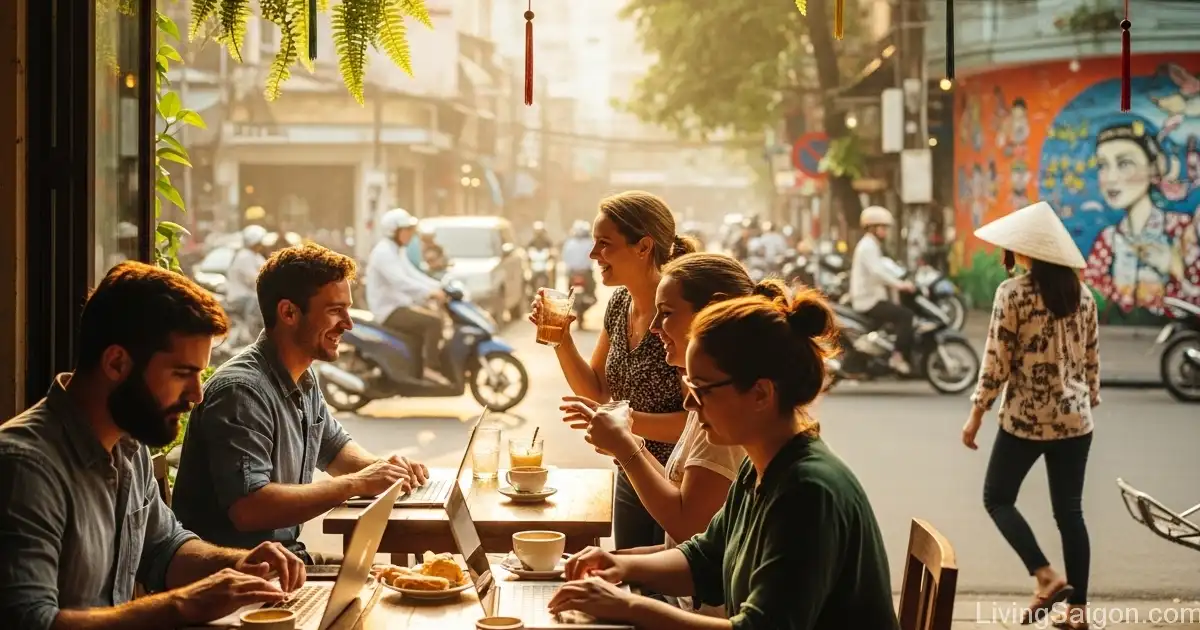
Before you move somewhere, you research the logistics — visa, cost, housing, healthcare. But what you actually want to know, underneath all of that, is something harder to quantify: what does it feel like to live there? What does a Tuesday look like? What do you do on a Sunday morning? How long before it starts to feel normal? This page is about expat life in Saigon at that level — the texture of day-to-day life in one of Southeast Asia’s most exciting cities, written by people who have actually lived it.
The short version: it’s chaotic, it’s energizing, it’s occasionally frustrating, and the overwhelming majority of people who move here end up staying longer than they planned. The longer version is what follows. For a full overview of everything involved in the move itself, start with the living in Saigon guide.
What Expat Life in Saigon Actually Looks Like Day to Day
One of the first surprises for people who move here is how quickly a routine forms. Within two or three weeks, most expats have a morning cafe, a preferred lunch spot, a route to work, and a handful of go-to places for the evening. Saigon is a city that rewards repetition — the more familiar you become with your neighborhood, the richer your experience of it gets.
A typical weekday morning for many expats starts with coffee, and the coffee in this city is taken seriously. Whether it’s a plastic cup of cà phê sữa đá from the stall on the corner — strong, sweet, and cheap enough to buy twice — or a carefully brewed pour-over at one of the city’s specialty roasters, the morning coffee ritual is a near-universal part of expat life in Saigon. The best cafes in Saigon guide covers the scene by neighborhood if you’re still finding your spot.
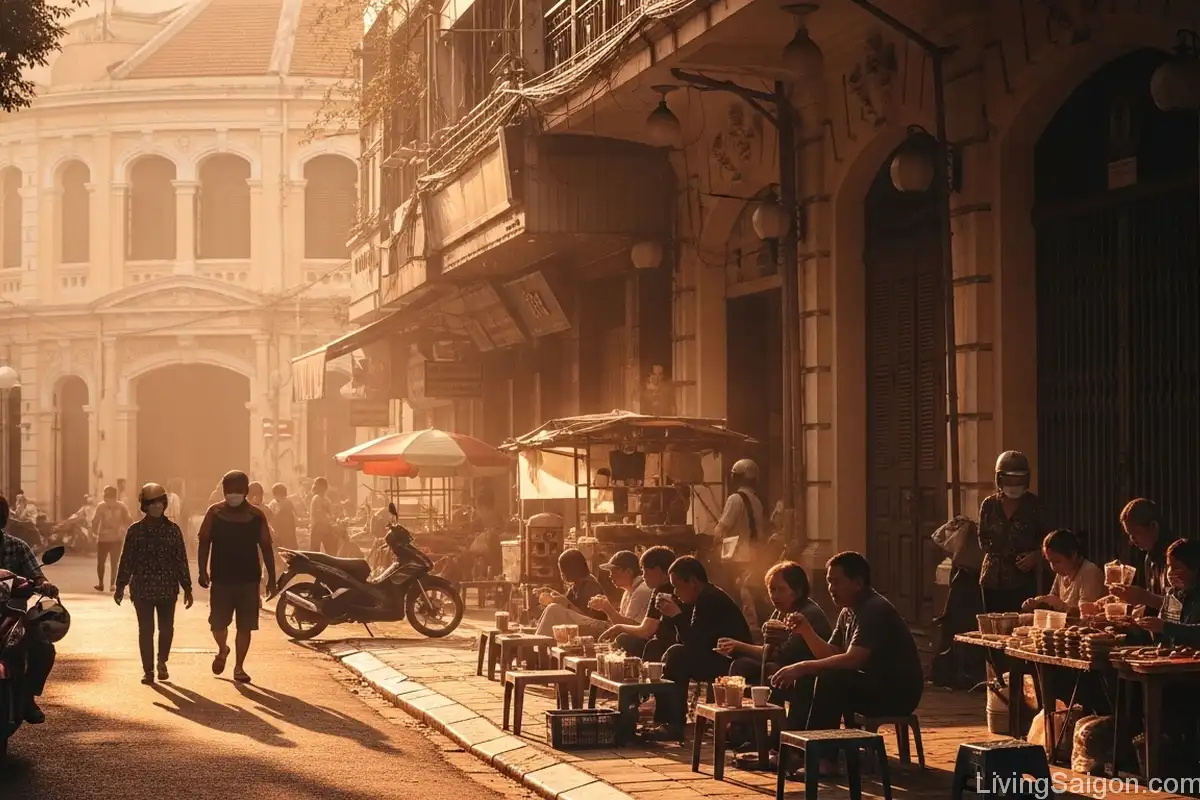
Lunch is one of the genuine daily pleasures of living here. At most offices, construction sites, and businesses across the city, the lunch break involves going out. The streets around any commercial area fill up between noon and 1:30pm with people eating at outdoor tables, at plastic stools, or at the ground-floor restaurants that operate only for the midday rush. A proper meal — rice, protein, vegetables, soup — costs 50,000–80,000 VND ($2–3.50) at a good local spot. The food at these places is almost always excellent. For an in-depth look at the eating culture, the food in Saigon guide is the place to start.
Afternoons in Saigon are hot. Between 1pm and 4pm, the city slows slightly — air conditioning becomes a genuine productivity tool, and the rhythm of the city adjusts to the heat. Working from a cafe is completely normal here; many expats choose cafes with good wifi and reliable power outlets as their primary work environment, which suits the city’s culture perfectly.
The Evening Rhythm of Expat Life in Saigon
The city comes back to life in the late afternoon. By 5pm, the streets are filling again. The working day ends, the food stalls set up for the evening, and the social possibilities open up. Expat life in Saigon after dark can be as active or as quiet as you want it to be — that’s genuinely one of its strengths.
On any given weeknight, you could go for pho at a local place that’s been open since before you were born. You could watch live music at one of the bars in the Pham Ngu Lao area. You could have drinks at a rooftop bar with the skyline spread out below you. You could cook at home, call your family, and be in bed by 10pm. Nobody judges you in any direction. The city has options for every mood, and it runs late enough that you never feel rushed.
Weekends take on a different character. Saturday mornings in Thao Dien bring the international farmers market and a brunch scene that draws most of the neighborhood. Sunday afternoons are for exploring — a new district you haven’t walked around yet, a museum, a day trip. The range of things to do within a two-hour radius of the city is significant: the Mekong Delta, Vung Tau beach, Cu Chi Tunnels, the jungle retreats of Binh Duong.

Social Life and Making Friends as an Expat in Saigon
This is one of the most common questions from people considering the move, and the honest answer is that Saigon is unusually easy for building a social life, especially compared to larger Western cities. Several factors work in your favor.
First, there’s a large and active expat community, particularly concentrated in Thao Dien, Binh Thanh, and District 1. Many people arrive without knowing anyone, which means there’s a constant supply of newcomers who are also looking to connect. The social activation energy is lower than in cities where people have established social circles and aren’t actively looking to expand them.
Second, the activities that anchor social life here are genuinely sociable. Sports leagues — touch rugby, running clubs, volleyball, football, tennis, CrossFit communities — draw mixed groups of expats and locals and are one of the most reliable ways to meet people with shared interests. Language exchange events (Vietnamese for English, or vice versa) have an obvious built-in social mechanic. The bar and cafe scene is genuinely friendly rather than exclusive.
Third, Facebook groups remain surprisingly effective here. Expats in Ho Chi Minh City, HCMC Expats, and neighborhood-specific groups see real activity — recommendations, meetups, and the kind of real-time local knowledge that no guidebook can provide. Joining a few of these before you arrive and introducing yourself is one of the quickest ways to have a face to recognize on arrival. Our article on making friends in Saigon as an expat covers the best ways to connect in more detail.
The relationship between expats and the local Vietnamese community is something worth thinking about. The best social experiences in Saigon tend to happen when expats don’t stay exclusively within the international bubble. Vietnamese friends offer a completely different window into the city — the real neighborhoods, the genuine food, the local culture, the perspectives that you won’t find in any guide. Learning even basic Vietnamese dramatically accelerates this.
Working in Saigon: Remote Work, Local Jobs, and the Digital Nomad Scene
The working population of the expat community breaks roughly into three groups: people employed by local Vietnamese companies or registered foreign enterprises, people working remotely for companies based elsewhere, and the self-employed or freelance group that blurs the lines between the two.
The local job market has genuinely developed over the past decade. Saigon is Vietnam’s commercial capital, and real career opportunities exist across tech, finance, manufacturing, education, hospitality, and a growing startup ecosystem that has attracted significant venture investment. The language barrier matters less than in some markets — English is the business language in most international-facing companies — but salary expectations are different. Local salaries are lower than what you might earn at home, though the cost of living offset makes the comparison more complex than the headline number suggests.

Remote Work and the Cafe Office Culture
Saigon has become one of Southeast Asia’s more popular remote work bases, and for good reasons. The fiber internet infrastructure is genuinely good — speeds of 100Mbps+ are standard at most cafes and coworking spaces. The cost of living means that a remote salary in USD or EUR goes very far. The timezone, while challenging for US West Coast overlap, aligns reasonably with European morning hours and covers most of Asia comfortably.
The coworking scene has developed substantially. Toong, Dreamplex, and Circo are well-established chains with multiple locations across the city’s main expat areas. Day passes run roughly $10–20 USD, monthly memberships $100–200 USD depending on location and access level. Most include high-speed wifi, coffee, meeting room access, and the kind of atmosphere that makes sustained work easier than a home desk. For a curated guide to the best options, our article on the expat community in Saigon covers work-life infrastructure including the best coworking spots.
For many remote workers, the line between office and cafe is blurry by design. Sitting in a cafe for three or four hours with a laptop is socially accepted here in a way it isn’t in some cities. Most cafes have wifi; many have power outlets at the tables. The combination of good coffee, reasonable ambient noise, and affordable prices makes them a genuinely effective work environment.
Daily Routines: Fitness, Health, and Staying Active
Expat life in Saigon can be as health-conscious as you want it to be, and the infrastructure for it is better than many people expect from a Southeast Asian city.
The gym scene is strong. California Fitness, Elite Fitness, Fit24, and dozens of independent gyms are scattered across the expat neighborhoods, with monthly memberships typically running $30–80 USD depending on the facility. CrossFit boxes, yoga studios, muay thai gyms, and pilates studios all have active expat followings. If you have a sport or fitness practice back home, there’s a good chance you’ll find it here.
Running in Saigon requires some adaptation. Air quality is not always ideal, and the footpaths in many areas are inconsistent. Most serious runners do their long runs in the early morning — before 7am, before the traffic and heat build up — or head to parks like Tao Dan in District 3, Gia Dinh in Phu Nhuan, or the riverside walkway near District 1. Running groups, including the Hash House Harriers and several more formal running clubs, provide both structure and community.
Health and Wellness in Saigon
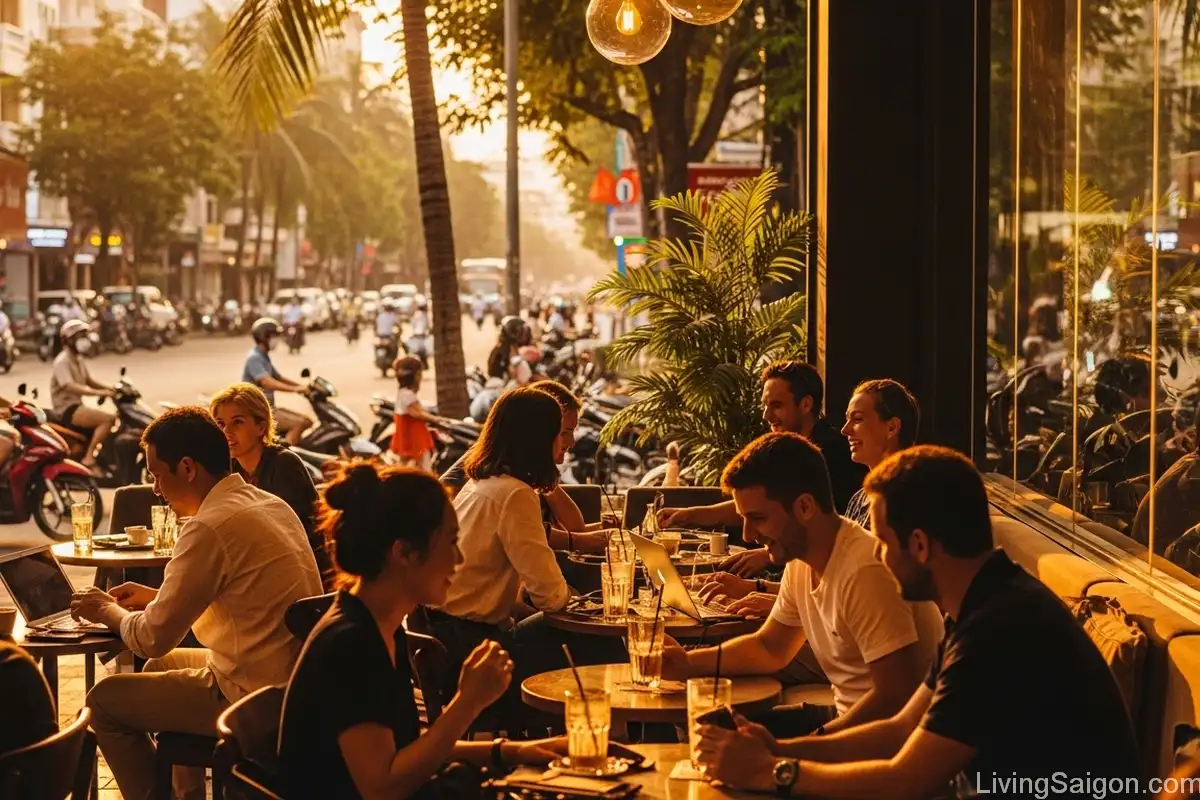
The wellness infrastructure has improved considerably over the past decade. Yoga studios in Thao Dien and District 3 offer classes at a variety of levels and styles. Meditation centers, traditional Vietnamese massage, and wellness spas are accessible and affordable. The food supply — fresh markets, organic options at Annam Gourmet and a growing number of health-focused grocers — makes eating well relatively straightforward.
Mental health support for expats has also become more available. English-speaking therapists and counselors operate in the city, both in person and via telehealth. The transition to a new country, even an exciting one, has real psychological dimensions — the initial honeymoon period, the adjustment dip, the building of a new support network — and having professional support available matters.

The Instagram-Worthy Side of Expat Life in Saigon
There’s a version of Saigon that exists in beautiful photographs — rooftop pools, photogenic cafes, golden hour street scenes, bowls of pho that steam perfectly in the morning light. That Saigon is real. But it coexists with the chaotic, imperfect, occasionally infuriating city that’s also real. Part of what makes expat life in Saigon interesting is the constant negotiation between these two versions.
The visual appeal of the city is genuine and does not require significant effort to access. You can walk out of your apartment in Thao Dien on a Sunday morning and find yourself in a scene that looks like it was art-directed. The Instagram spots in Saigon guide covers the most photogenic locations across the city if you want a curated list, though some of the best photos happen by accident on streets you didn’t plan to walk down.
The rooftop bar scene in particular is a significant feature of the social and visual landscape. A dozen or more rooftop venues across the city offer city views at sunset, and the best of them combine genuine quality with the kind of backdrop that justifies every cliché. For a dedicated guide to the scene, our weekend activities in Saigon article covers the rooftops alongside a wider range of things to do.
The Harder Parts of Expat Life in Saigon
Honest coverage of expat life in Saigon requires acknowledging the parts that take adjustment — and in some cases, that you simply never fully adjust to.
The heat is constant and unrelenting for most of the year. The rainy season (May to October) brings daily afternoon downpours that last thirty to sixty minutes, followed by humidity that makes everything feel damp. The dry season (November to April) is more comfortable but still hot by most standards. Most expats adapt within a few months — your internal thermostat genuinely recalibrates — but you never quite forget that you live close to the equator.
The noise is real. Saigon is a city that operates continuously. Construction starts early. Motorbike engines are the city’s ambient sound. Karaoke is taken seriously by many of the city’s residents and is not always limited to polite hours. Finding a genuinely quiet apartment requires specifically looking for one — double-glazed windows, a building set back from main roads, and a higher floor all help.
Homesickness is not a weakness — it’s a predictable part of relocating, and it typically hits hardest in months two through four, after the initial excitement of novelty has settled but before the new life has fully taken root. Most long-term expats describe a period where they genuinely questioned whether they’d made the right choice, followed by a turning point where the city stopped feeling like a place they were visiting and started feeling like home.
Loneliness can be a challenge even in a city with an active social scene, particularly for people whose personalities tend toward introversion or who find networking-style socializing draining. The solution is usually the same: find your thing — a sport, a creative pursuit, a regular volunteer commitment — that puts you in recurring contact with the same people over time. Depth of connection comes from repeated shared experience, not from single social events.
Building a Community: The Long Game of Expat Life in Saigon
The expats who thrive here over the long term tend to share certain characteristics. They’re adaptable — willing to find solutions when things don’t work the way they expect. They’re curious — genuinely interested in the city beyond the expat enclave. And they’re patient with themselves during the adjustment period, which is real and takes longer than most people anticipate.
They also tend to have found their community within the larger expat population. Saigon’s international community is large enough that there are genuine sub-communities — by nationality, by industry, by neighborhood, by interest. The digital nomad community in Thao Dien is different from the finance professional community in District 1, which is different from the teacher community spread across every district. Finding the pocket of the city that fits your profile makes the whole experience significantly easier.

Our article on daily life in Saigon for expats goes deeper on the day-to-day specifics — including what the first week looks like, how to navigate the practical setup period, and what to expect in the first three months. If you’re thinking about where to base yourself, the where to live in Saigon guide walks through every major neighborhood with the kind of detail that actually helps you decide. And if you want help with the arrival logistics — airport pickup, apartment search, first-week setup — our expat support services are built exactly for that moment.
Expat life in Saigon is not for everyone. But for the people it suits, it’s one of the best decisions they’ve ever made. The city doesn’t explain itself — it rewards the effort of understanding it. And once you’ve put in that effort, it’s genuinely hard to imagine living anywhere else.